Understanding Prediction and Tolerance Intervals for Spring Lifetimes
80 likes | 216 Vues
This piece explains the concepts of prediction intervals and tolerance intervals in the context of estimating the lifetimes of springs. We have a 90% confidence that the average lifetime of springs lies between 149.1 and 187.5. When estimating next spring's lifetime, the prediction interval will be wider due to inherent variability. Additionally, we can define a tolerance interval to ensure we are 95% confident that 99% of the lifetimes fall within a specified range. Understanding these intervals is crucial for accurate predictions in statistical analysis.


Understanding Prediction and Tolerance Intervals for Spring Lifetimes
E N D
Presentation Transcript
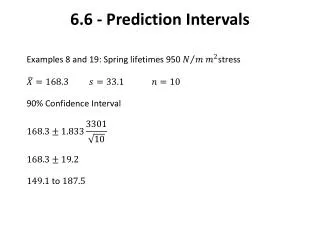
90% confidence interval for is 149.1 to 187.5. We are 90% confident that the overall (population) average lifetime is between 149.1 and 187.5 • For the next spring for what interval of lifetimes are we 90% confident that this spring’s lifetime will fall in this interval? This is a prediction interval. • The prediction interval will be wider than the confidence interval. Even if we knew exactly, (zero width confidence interval) variability from spring to spring would make the nextspring’slifetime not exactly equal to.
Our ability to predict the next spring’s lifetime depends on 2 things: • How well we have estimated and • How variable individual springs are
Tolerance Interval: I want to specify an interval of lifetimes such that I am 95% confident that 99% of the springs’ lifetimes fall in this interval. Or we could find a one-sided tolerance interval (a guarantee) such that I am 95% confident that 99% of the springs meet the guarantee. • There are tables to find these intervals, but we won’t be finding tolerance intervals.