Download
1 / 4
40 likes | 142 Vues
This document outlines the latest improvements in A/V capabilities, including enhanced data streaming and error reporting features for A/V applications. Highlights include the introduction of new commands for read and write operations, improved recovery time limits, and support for mixed A/V and PC applications. The implementation of acoustic seek modes and stream rate negotiation ensures optimized performance for users, while the use of PIO and DMA transfers is emphasized. Future updates will clarify currently undefined features, solidifying the A/V data transfer framework.

E N D
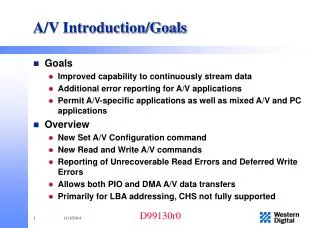
A/V Introduction/Goals • Goals • Improved capability to continuously stream data • Additional error reporting for A/V applications • Permit A/V-specific applications as well as mixed A/V and PC applications • Overview • New Set A/V Configuration command • New Read and Write A/V commands • Reporting of Unrecoverable Read Errors and Deferred Write Errors • Allows both PIO and DMA A/V data transfers • Primarily for LBA addressing, CHS not fully supported
A/V Data Transfer Periods • A/V Read and Write Recovery Time Limits are allotted times for complete command execution • Commands shall execute in the specified time period including data transfer and final status • Recovery Time Limits are not individually selectable on a per stream basis as currently defined • Host will typically transfer an application specific amount of data per period
Read A/V Stream Command • URGent is a temporary overide to the Recovery time limit and effectively means “As Soon As Possible” • The actual action performed by the drive when URG is specified is vendor specific • Stream ID is a hint that indicates which stream the command is associated with • Use of or behavior specific to Stream ID is vendor unique
Things That Are Missing... • Acoustic Seek Modes • Useful feature - No objection to SeaStream’s implementation • WD doesn’t believe this is A/V specific, i.e., PCs may very well want to trade lowered acoustics for performance • PIO is not missing… • Feedback indicates PIO transfer adequate for some A/V applications currently • Buffering in drive can alleviate some of the performance deficit associated with PIO transfers • Stream Rate Negotiation • Some Features Not Adequately Defined Yet • Updated document with clarifications will be available “soon”