Download
1 / 11
110 likes | 218 Vues
This study focuses on enhancing the South Pole Telescope's (SPT) ability to accurately locate Sagittarius A*, the supermassive black hole at the center of the Milky Way. By implementing a refined online pointing model, the study aims to correct atmospheric and pointing offsets. The methodology involved using the Planck Catalogue of Compact Sources and filtering data through MATLAB to select optimal point sources for observation. Results show improved detection capabilities, paving the way for future collaborations with the Event Horizon Telescope (EHT) network for advanced astronomical studies.

E N D
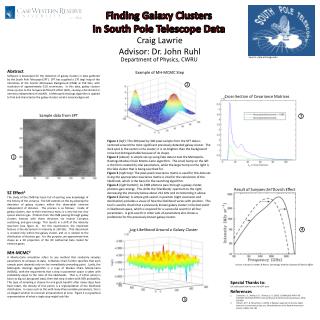
Implementing A Pointing Model for the South Pole Telescope Rita Ezeugwu Mentor: Christopher Greer
Introduction • Activity observed in the center of the Milky Way – massive black hole • Supermassive Sagittarius A* (Sgr A*) is studied to learn about the accretion of material affected by its gravitational environment • Knowing the characteristics of Sgr A* provides a deeper understanding of astrophysics and scientific principles that describe general relativity
South Pole Telescope • South Pole Telescope (SPT) points towards Sgr A* for observation • Event Horizon Telescope (EHT) network Source: Christopher Greer Source: http://t.co/gUpo5hAcZR
Objective • Correct atmospheric and telescope pointing offsets associated with SPT to clearly locate Sgr A* by using an online pointing model • Apply an updated pointing model for SPT to detect other discrete objects for collaboration with EHT observations. • Obtain data of Southern Sky Source: Christopher Greer
Methodology • Collect the brightest and most compact point sources with Planck Catalogue of Compact Sources (PCCS) • Frequencies: 217 GHz, 353 GHz • Selection of point sources • Filtered with MATLAB • Position • Brightness • Angular extent • Set of Identifications, Measurements, and Bibliography for Astronomical Data (SIMBAD)
SIMBAD: 217 GHz Data Point Identifier: [PAH2004] I Coordinates: 272.155 -19.866 Radius : 1 arcmin Source: http://simbad.u-strasbg.fr/
Results 217 GHz (left) and 353 GHz (right) data
Conclusion • Now have collection of sources to observe • Future work • Create software that analyzes the list of calibration observations to produce pointing model parameters • March 2015
Acknowledgements • UA NASA Space Grant Program • Barron Orr • Susan Brew • UA Department of Astronomy • Dr. Daniel Marrone