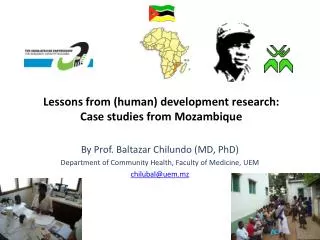
Lessons from (human) development research: Case studies from Mozambique
120 likes | 231 Vues
This paper by Prof. Baltazar Chilundo explores the landscape of health research in Mozambique, addressing the crucial role of research in improving health outcomes and achieving the Millennium Development Goals (MDGs). It highlights the need to bridge the "know-do gap" and emphasizes the importance of conducting various types of health research, including clinical, operational, and public health studies. The study covers ongoing research projects, institutional frameworks, and the challenges faced in utilizing research findings for effective policy-making and practice.


Lessons from (human) development research: Case studies from Mozambique
E N D
Presentation Transcript
Lessons from (human) development research:Case studies from Mozambique By Prof. Baltazar Chilundo (MD, PhD) Department of Community Health, Faculty of Medicine, UEM chilubal@uem.mz
Background: Mozambique Profile IAP for Research Capacity Building Source: *Childhood Poverty: A Situation and Trends, ** MISAU 2007 Analysis, UNICEF, 2006 other: UNDP Mozambique 2006
Background • Focus on Human Development (Sen, 1999) • Better health is an essential ingredient and consequence of development • Research as a central and indispensable component of improving health and hence for achieving MDGs • Bridging the “know-do gap” • Conducting more research IAP for Research Capacity Building
The spectrum of health research in Mozambique • Clinical & Biomedical research ++++ • Operational research ++ • Public Health Epidemiological research + • Social sciences and behavioral research + • Health policy and systems research +/- • Environmental health research +/- IAP for Research Capacity Building
Institutions conducting health research • National Institute of Health – MoH • Research… • National Bioethics Committee • Faculties of Medicine/Health Sciences: • UEM ++; Higher Institute of Health Sciences; Catholic University; UniLurio; UniZambeze and Higher Institute of Science/Technology • Research Centres • Manhica Health Research Centre • Beira Operational Health Research Centre IAP for Research Capacity Building
Mapping urinary bilharzias and intestinal parasitosis in Mozambique Know – do Gap By: National Institute of Health/MoH (2007) on deglected diseases Intestinal Parasitosis Prevalence at districts Bilharzias Prevalence at districts IAP for Research Capacity Building
“mapping lymphatic Filariasis in Moçambique” By: Know – do Gap By: National Institute of Health/MoH (2007) on deglected diseases Nampula Province with 54% of filariasis IAP for Research Capacity Building
Some ongoing research projects in the Community Health Department/UEM • Routine Iron Prophylaxis during Pregnancy - Effects on Maternal and Child Health in Maputo City and Maputo Province Mozambique (2 countries) • Experience of African Countries with GHIs (8 countries: 4 south) • HRH developmentinTeteProvince (2 countries) • Health Systems Strengthening for Equity: The Power and Potential of mid-level healthcare providers in Mozambique (5 countries: 3 south) • Country Situation on Child Maltreatment Prevention in Mozambique (w/ WHO) • Strengthening Integrated Primary Health Care in Sofala Province, Mozambique IAP for Research Capacity Building
Age groups 0–27 Days 28 d – 11 months 12–59 months 6-14 years 1st Prematurity (31%) Malaria (22.6%) Malaria (31.4%) Malaria (18.2%) 2nd Birth asphyxia (16.3%) Pneumonia (19.1%) Malnutr. (20.1%) Traumatism (10.4%) 3rd Septicaemia (14.6%) Malnutr. (10.0%) Pneumonia (10.4%) Traumatism (10.4%) 4th Pneumonia (10.6%) Diarrhea (8.0%) Diarrhea (6.0%) Pneumonia (9.1%) 5th No consensus (7.3%) Meningitis (7.5%) No consensus (5.7%) Meningitis (9.1%) Manhiça health Research Centre at a glance Causes of paediatric death in the community The biomedical rural-based research centre’s agenda is based on the main causes of disease and death in children less than 5 years and pregnant women: malaria, HIV/AIDS, pneumonia and diarrhoea • Some examples: • Clinical trials for malaria vaccine • Clinical development of new antimalarial drugs • Evaluation of the impact of the Haemophilus influenzae type b vaccine • Feasibility studies for clinical trials of microbicides and for HIV vaccines IAP for Research Capacity Building
The hiatus between policy and practice • 2025 agenda; 5y Government Plan; Science and Technology Policy and Strategy, UEM strategic and Research plans… • Many publications available but the recommendations are hardly known by decision makers = Know-Do Gap • Lack of national research open access warehouse • The process of sharing health research based only on a few national mechanisms: (i) quarterly medical journal with quality problems although is a peer-review based (ii) health journey held every 4 years… IAP for Research Capacity Building
Research conducted in ad hoc manner • Lack of tracking system after approval by the only existing national bioethics committee • Lack of specific health research agenda undermining informed based decisions • Research mainly conducted as per donor request and fashion not primarily as part of implementing organization’s agenda • External aid is needed to support local research capacity building IAP for Research Capacity Building