Understanding Conditional Statements in Geometry: Mrs. Spitz's Fall 2005 Class
In Mrs. Spitz's geometry class, students will explore geometric concepts by learning about conditional statements. The objectives include the recognition and analysis of these statements, writing postulates related to points, lines, and planes, and understanding the components of conditional statements, such as hypotheses and conclusions. Students will practice rewriting statements, identifying counterexamples, and exploring inverse, converse, and contrapositive forms. Assignments will allow students to apply and solidify their understanding of these important logical constructs.

Understanding Conditional Statements in Geometry: Mrs. Spitz's Fall 2005 Class
E N D
Presentation Transcript
2.1 Conditional Statements Mrs. Spitz Geometry Fall 2005
Standards/Objectives: • Students will learn and apply geometric concepts. • Objectives: • Recognize and analyze a conditional statement • Write postulates about points, lines, and planes using conditional statements.
Assignment: • Pp. 75-77 #4-28 all, 46-49 all.
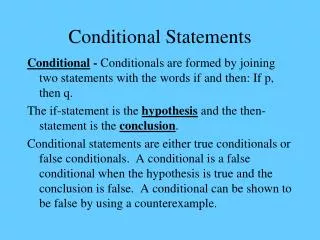
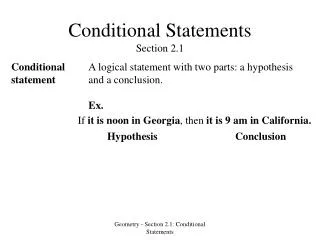
Conditional Statement • A logical statement with 2 parts • 2 parts are called the hypothesis & conclusion • Can be written in “if-then” form; such as, “If…, then…”
Conditional Statement • Hypothesis is the part after the word “If” • Conclusion is the part after the word “then”
Ex: Underline the hypothesis & circle the conclusion. • If you are a brunette, then you have brown hair. hypothesis conclusion
Ex: Rewrite the statement in “if-then” form • Vertical angles are congruent. If there are 2 vertical angles, then they are congruent. If 2 angles are vertical, then they are congruent.
Ex: Rewrite the statement in “if-then” form • An object weighs one ton if it weighs 2000 lbs. If an object weighs 2000 lbs, then it weighs one ton.
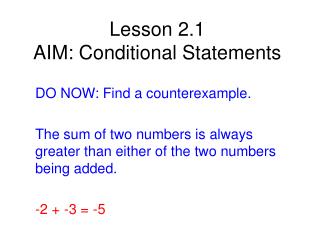
Counterexample • Used to show a conditional statement is false. • It must keep the hypothesis true, but the conclusion false! • It must keep the hypothesis true, but the conclusion false! • It must keep the hypothesis true, but the conclusion false!
Ex: Find a counterexample to prove the statement is false. • If x2=81, then x must equal 9. counterexample: x could be -9 because (-9)2=81, but x≠9.
Negation • Writing the opposite of a statement. • Ex: negate x=3 x≠3 • Ex: negate t>5 t 5
Converse • Switch the hypothesis & conclusion parts of a conditional statement. • Ex: Write the converse of “If you are a brunette, then you have brown hair.” If you have brown hair, then you are a brunette.
Inverse • Negate the hypothesis & conclusion of a conditional statement. • Ex: Write the inverse of “If you are a brunette, then you have brown hair.” If you are not a brunette, then you do not have brown hair.
Contrapositive • Negate, then switch the hypothesis & conclusion of a conditional statement. • Ex: Write the contrapositive of “If you are a brunette, then you have brown hair.” If you do not have brown hair, then you are not a brunette.
The original conditional statement & its contrapositive will always have the same meaning. The converse & inverse of a conditional statement will always have the same meaning.