Interactions in Communities: Understanding Predator-Prey, Competition, and Symbiosis
In community interactions, organisms engage in various relationships essential for survival. These interactions encompass predation, competition for resources, and symbiotic relationships such as mutualism, commensalism, and parasitism. Predators and prey are locked in a struggle for survival, while herbivores coexist with plants that have developed defenses. Symbiosis highlights the varied connections between species, where mutualism benefits both partners, commensalism aids one without harming the other, and parasitism exploits the host, often causing harm. Understanding these dynamics is key to grasping ecological interdependence.

Interactions in Communities: Understanding Predator-Prey, Competition, and Symbiosis
E N D
Presentation Transcript
Community Interactions Chapter 5 Section 2: Interactions in Communities Pages 109-111
Introduction Interactions in communities can take many forms. Predators and prey are locked in a struggle for survival. Organisms with the same needs compete for food. Parasites and hosts try to get ahead of one another. Some organisms even depend on one another for survival. (Holt, page 109)
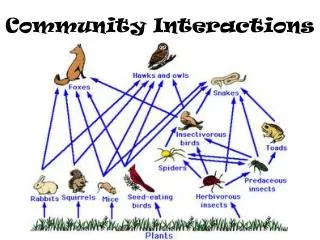
Living Relationships • Predation—one organism (predator) captures and feeds on another organism (prey) • Predators come is all sizes!
Living Relationships • Herbivory—herbivores that eat plants without killing the plant • Plants use various defenses against herbivory • What are they?
Living Relationships • Competition—when organisms attempt to use the same resource in the same place at the same time
Symbiosis • Symbiosis—relationships between different species living closely together • Sym- “together”, -biosis “living” • Three types: • Mutualism • Commensalism • Parasitism
Mutualism • Mutualism—both species benefit • Examples: bacteria in digestive tract, fish and shrimp that clean bigger fish and turtles
Commensalism • Commensalism—one member benefits, the other is not helped nor harmed • Examples:Bromeliads live in the tops of the trees in rain forest without harming trees
Spanish Moss is an epiphyte (type of plant that grows on other plants for support, moisture, and sunlight)
Parasitism • Parasitism- one organism (parasite) lives off the other organism (host) while harming it but not killing the host! • Parasites can live on or in the host • Examples:ticks, fleas, mosquitoes, heartworm, leeches