Bones
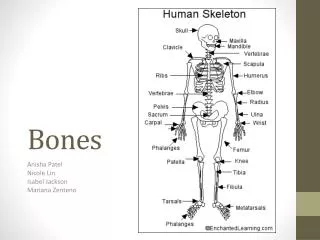
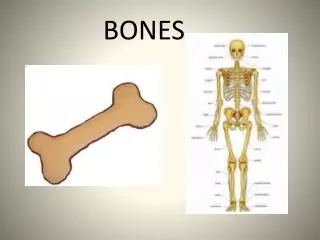
The human skeleton comprises 206 bones, categorized into the axial and appendicular skeletons. Bones are dynamic organs made of various tissues, including bone, cartilage, epithelial, and nervous tissues. The shapes of bones can differ, being categorized as long or irregular. Bone growth occurs through intramembranous and endochondral processes, with spongy bone found at the ends of long bones, while compact bone forms the outer layers. Understanding bone fractures is crucial, as they heal more rapidly in younger individuals and vary between upper and lower limbs and spongy versus compact bones.

Bones
E N D
Presentation Transcript
Subdivisions • Axial • Appendicular
Bones are organs composed of the following tissues: • Bone tissue • Cartilage • Epithelial • Fibrous connective tissue • Blood connective • Nervous tissue
Long –vs- Irregular Bone Irregular Bone
Types of Bone Growth • Intramembranous • Skull • Comes from primitive connective tissue cells • Endochondral • All other • Comes from cartilage
Spongy found in the expanded end region of long bones and fills irregular space. Compact on outer bone and shafts of long bones. Spongy –vs-Compact
Fractures heal more quickly: -in young individuals -in upper limbs as opposed to lower limbs -in spongy bones –vs- compact bone