Exploring Maps, Gradients, and Time Zones: A Geographic Trivia Challenge
Dive into the world of geography with this engaging trivia game focused on maps, gradients, and time zones. From understanding road maps and conic projections to exploring topographic features and isotherms, test your knowledge on how to read and interpret different types of maps. Challenge yourself with questions about latitude, longitude, and the science behind time zones. Perfect for geography enthusiasts, educators, and students looking to enhance their understanding in a fun and interactive way!


Exploring Maps, Gradients, and Time Zones: A Geographic Trivia Challenge
E N D
Presentation Transcript
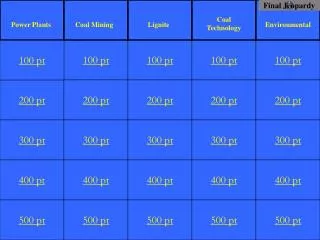
Game board Isotherms & Contour Lines Maps Gradient Latitude & Longitude Time Zones Miscellaneous $100 $100 $100 $100 $100 $100 $200 $200 $200 $200 $200 $200 $300 $300 $300 $300 $300 $300 $400 $400 $400 $400 $400 $400 $500 $500 $500 $500 $500 $500
1-100 1 - 100 This type of map is used to get from place to place using roads. $100
1-100A 1 - 100 What is a road map? Return $100
1-200 This map is created by placing a cone over a portion of the earth. $200
1-200A 1 - 100 What is a conic map? Return $200
1-300 It is the type of map projection seen here. $300
1-300A 1 - 100 What is a Robinson Projection? Return $300
1-400 This type of map shows changes in elevation. $400
1-400A 1 - 100 What is a topographic map? Return $400
1-500 It is the map projection that is most often used by airplane pilots. $500
1-500A 1 - 100 What is a Gnomonic projection? Return $500
2-100 1 - 100 When the slope or gradient is steep, the contour lines look like this. $100
2-100A 1 - 100 What is close together? Return $100
2-200 When contour lines are far apart you have this type of slope. $200
2-200A 1 - 100 What is a low or shallow slope? Return $200
2-300 This is the gradient between two points that are 10 km apart and have a change in elevation of 500 feet. $300
2-300A 1 - 100 What is 50 feet/km? Return $300
2-400 This is how energy flows between the sink and the source. $400
2-400A 1 - 100 What is from the source to the sink? Return $400
2-500 This is the gradient between points E and D if they are a distance of 2 km apart. $500
2-500A 1 - 100 What is 40m/2km = 20 m/km? Return $500
3-100 1 - 100 This is the zero degree line for latitude. $100
3-100A 1 - 100 What is the equator? Return $100
3-200 This is your latitude if you measure the altitude of Polaris to be 43º above the horizon. $200
3-200A 1 - 100 What is 43º North? Return $200
3-300 This line is 180º from the Prime Meridian. $300
3-300A 1 - 100 What is The International Date Line? Return $300
3-400 Traveling North along a line of longitude will make the North star do this. $400
3-400A 1 - 100 What is get higher in the sky? Return $400
3-500 This is what happens to the width of lines of longitude as you move from the poles towards the equator. $500
3-500A 1 - 100 What is increase in width? Return $500
4-100 1 - 100 This is the creator of time zones. $100
4-100A 1 - 100 Who is Sir Sanford Fleming? Return $100
4-200 This country is the host of the original Prime Meridian. $200
4-200A 1 - 100 What is France? Return $200
4-300 This number is the approximate width of each time zone in degrees. $300
4-300A 1 - 100 What is fifteen? Return $300
4-400 This is used to measure time zones. $400
4-400A 1 - 100 What are lines of longitude? Return $400
4-500 You take a 4 hour flight from California to Connecticut that leaves at 5 am. This is the time that you arrive. $500
4-500A 1 - 100 What is 12 noon or 12 pm? Return $500
5-100 1 - 100 This is equal on every point of a contour line. $100