

SlideServe
Menu
Préférences
© SlideServe · v2026

Differentiation

metta avatar
16 diapositives · 396 Views · Aug 20, 2014

This guide introduces the fundamental concept of differentiation, focusing on finding the derivatives of functions like f(x) = x² and f(x) = x³. It explains the process of determining the gradient of curves at specific points and the significance of limits as h approaches 0. Key rules for differentiation, including the power rule and Leibniz notation, are covered with examples to illustrate how to calculate gradients and understand the rate of change. Additionally, the guide discusses the second derivative, highlighting its role in analyzing the slope of the first derivative.
Differentiation - slide 1
01 / 16Differentiation
1 / 17

Télécharger la présentation

Differentiation
Une image / un lien ci-dessous est fourni (tel quel) pour télécharger la présentation

Politique de téléchargement : le contenu du site vous est fourni TEL QUEL pour votre information et votre usage personnel ; il ne peut être vendu, concédé sous licence ni partagé sur d’autres sites sans l’accord de son auteur.Le contenu vous est fourni TEL QUEL, pour votre information et votre usage personnel uniquement. Téléchargez la présentation en cliquant sur ce lien. Lors du téléchargement, si vous ne parvenez pas à télécharger une présentation, l’éditeur a peut-être supprimé le fichier de son serveur.Pendant le téléchargement, si vous ne parvenez pas à obtenir une présentation, le fichier a peut-être été supprimé par l’éditeur.

F I N

Plus de contenu associé

Transcription de la présentation
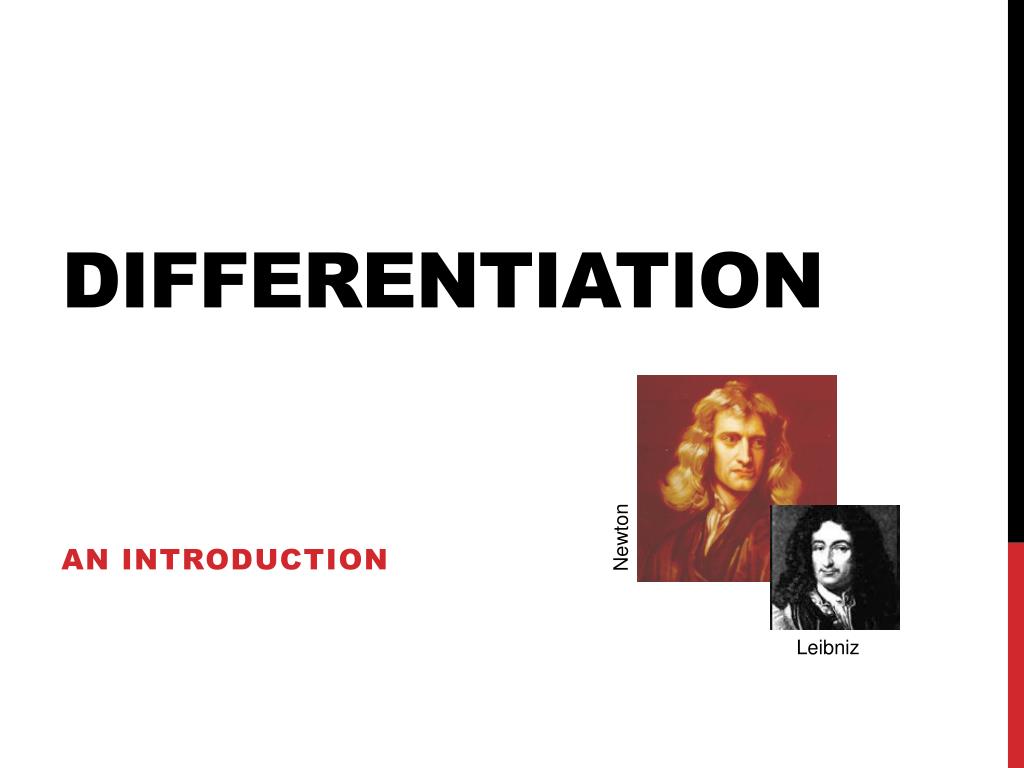
  1. Differentiation Newton An Introduction Leibniz

  2. . Q Find the gradient of the curve f(x)=x2 at the point P(x, f(x)) f(x +h) . P Draw a tangent at P and try and find the gradient of this tangent. f(x) x x + h Approximate this tangent by a chord PQ where Q=(x+h,f(x+h)) Now we can find the gradient of this chord ….

  3. Gradient at P is approximately : . Q . P

  4. As h approaches 0 then 2x + h approaches the gradient of the tangent. . Q But as h approaches 0 we can see that 2x + h approaches 2x . P We say that 2x is the limit of 2x+ h as h approaches 0 and write this as: h

  5. We now know the slope of the x2 at any point is 2x We call this gradient function the derived function or derivative We denote the derivative of f(x) by f’(x) The process of finding the derivative is called differentiation

  6. To summarise: If f(x)=x2 Then f’(x)=2x This means that if at the point x=3 the slope of the curve is 2(3)=6 Gradient =6 X=3

  7. Example: Find the derivative of f(x)=x3

  8. A general rule: If f(x)=xn Then f’(x)=nxn-1 Example: f(x) = x4 f(x) = 4x3

  9. More Rules … If f(x)=axn Then f’(x)=naxn-1 If f(x)=axn +bxm Then f’(x)=naxn-1 + mbxm-1

  10. Examples f(x)=2x3 +4x2 f’(x)=6x2 +8x f(x)=3x-2 - x-3 f’(x)= -6x-3 +3x-4 f(x)= x-1/2 f’(x)= -½x-3/2 f(x)= 4 f’(x)= 0

  11. Leibniz Notation Leibniz The derivative is sometime written using a notation introduced by Leibniz Example: y = x4 = 4x3

  12. Rate of Change The derivative measures the slope of a curve. When the curve represents a relation between variable x and a dependant variable y we interpret the derivative as the rate of change of y with respect to x y Gradient =Rate of Change of y with respect to x X

  13. Equation of a Line (Revision) We know the equation of a line is : If P(a , b) is a point on the line then we can find C

  14. Equation of Tangent y=f(x) y .P(a , b) Therefore the equation of the gradient at P X

  15. Equation of Normal The normal is the line perpendicular to the tangent y=f(x) y Remember: Gradient of tangent x gradient of normal =-1 .P(a , b) X

  16. Second Derivative The second derivative measures the slope of the first derivative. We write it like this: