The skeletal system
This comprehensive guide covers the human skeletal system, detailing components of both the axial and appendicular skeletons. It highlights the structure and function of bones such as the skull, vertebral column, hyoid, and ribs, as well as limb bones and girdles. Explore the bone markings that serve as attachment points for muscles, ligaments, and tendons. Learn about the cranial and facial bones, their roles in protecting vital organs, and the importance of bone structure in overall body mechanics. Ideal for students and enthusiasts in anatomy.

The skeletal system
E N D
Presentation Transcript
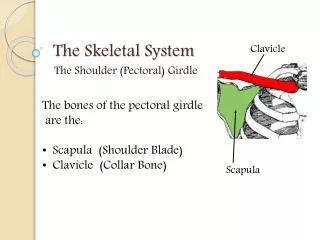
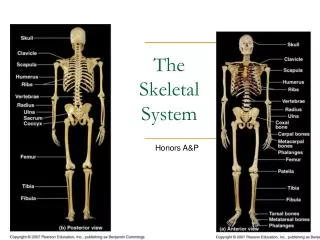
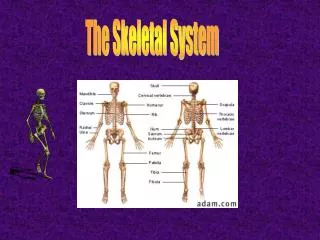
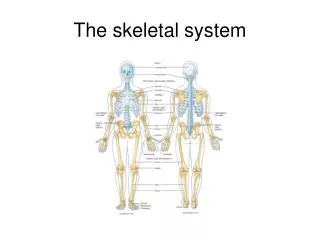
Axial skeleton (80) Skull Cranium 8 Face 14 Hyoid 1 Ossicles 3 Vertebral column 26 Thorax Sternum 1 Ribs 24 Appendicular (126) Pectoral girdles 2 clavicles, 2 scapulae Upper limbs 2 humerus, 2 radius, 2 ulna 16 carpals, 10 metacarpals, 28 phalanges Pelvic girdle 2 hip bones (coxae) Lower limbs 2 femurs, patellae, tibias, fibulas 14 tarsals, 10 metatarsals, 28 phalanges Bones of the adult skeletal system
Bone surface markings (table 5.1) • Raised areas where “pulling” occurs • Depressions where compression occurs • Major types of markings • Depressions and openings • Joints, pathways for blood vessels and nerves • Processes • Attachment points for ligaments and tendons
The skull • 8 cranial bones • Protects the brain • Supports blood vessels, nerves, etc. • Attachment sites for muscles • 14 facial bones • Framework of face • Support openings to digestive, respiratory systems • Attachment sites for muscles
Sutural (Wormian) bones • Located within sutures of certain cranial bones • Number varies among individuals
How is the skull held together? • Immovable joints (sutures) • Are movable during infancy and childhood • Often named according to the bones they join • Frontozygomatic, e.g. • Directional (frontal, sagittal) • Shape (lambdoid, squamous) • Only ossicles and mandible are movable
Cavities of the skull • Cranial • Orbits • Nasal • Paranasal sinuses
Functions of paranasal sinuses • Lined with mucous membranes • Resonating chamber
Major bones of the cranium • One frontal bone • Forehead • Roofs of orbits • Paired parietal bones • Attachment sites for meninges • Temporal bones • Zygomatic process • Mastoid process • External auditory meatus • Petrous portion (middle and inner ear)
Occipital bone • Foramen magnum • Occipital condyles (atlanto-occipital joints) • Nuchal lines: attachments sites for muscles
Sphenoid bone articulates with all other cranial bones Sella turcica protects the pituitary gland
Ethmoid bone • Lateral masses separate nasal cavilty from orbits • Roof- cribriform plate • Perpendicular plate- nasal septum • Crista galli- attachement site • Conchae facilitate respiratory function and sense of smell (inferior nasal conchae are separate bones)
Maxillae • Articulate with all facial bones except mandible • Contributes to orbits, nasal cavity and hard palate
Facial bones, continued • Zygomatic bones (cheekbones) • Lacrimal bones (orbits) • Palatine bones roof of mouth, part of nasal cavity and orbits • Inferior nasal conchae • Vomer forms part of nasal septum
Fontanels • Allow for flexibility and growth • Anterior fontanel is the most prominent and last to close (ossify)
Vertebral column Kyphosis Lordosis Scoliosis
26 bones in adult cervical vertebral column • 7 cervical • 12 thoracic • 5 lumbar • Sacrum has 5 fused vertebrae • Coccyx has 4 fused vertebrae
Lumbar and thoracic vertebrae lumbar thoracic
Summary • Axial skeleton consists of skull, ossicles, hyoid, vertebral column, sternum and ribs • Skull is composed of cranial and facial bones • Hyoid bone supports tongue and does not articulate with another bone • Vertebral column protects spinal cord • Thoracic cage protects vital organs