
Differentiation
E N D
Presentation Transcript
Differentiation Derivatives By: Doug Robeson
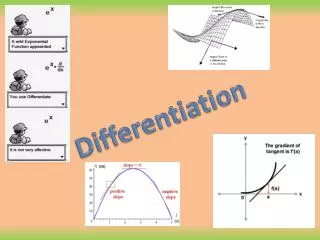
What is differentiation for? • Finding the slope of a tangent line • Finding maximums and minimums • Finding the shape of a curve • Finding rates of change and average rates of change • Physics, Economics, Engineering, and many other areas of study
Definitions of the Derivative • The slope of a tangent line to a function • Change in y over the change in x: dy/dx • The limit definition • lim f(x + h) - f(x)h0 h
Basic Derivative Rules • Power Rule: d(x^n) = nx^(n-1) • Constant Rule: d(c) = 0 Note: u and v are functions • Product Rule: d(uv)=uv’ + vu’ • Quotient Rule: d(u/v)=vu’ - uv’ v² • Chain Rule: d(f(g(x)))= f’(g(x))*g’(x)
Examples of Derivatives • d(x^3) = 3x^2 • d(4) = 0 • d((x+5)(3x-4)) = (x+5)(3) + (3x-4)(1) = 3x +15 + 3x – 4 = 6x + 11 • d((2x² + 4)³) = 3(2x² + 4)²(4x) = 12x(2x² + 4)²
More Examples • d((3x+4)/x²) = x²(3) – (3x+4)(2x) (x²)² = 3x² - 6x² - 8x x^4 = -3x – 8 x³
Applications of Derivatives • Finding tangent lines • Finding relative maxes and mins
Finding Tangent Lines • The derivative is the equation for finding tangent slopes to a function • To find the tangent line to a function at a point: • Take derivative • Plug in x value (this gives you slope) • Put slope and point into point slope form of the equation of a line
Find the tangent line to y = 3x³ + 5x² - 9 when x = 1. dy/dx = 9x² + 10x slope = 9(1)² + 10(1) = 9 – 10 = -1 Have slope, need point: y = 3(1)³ + 5(1)² - 9 = -1point: (1,-1) slope: -1y – (-1) = (-1)(x – (1))y + 1 = -x +1y = -x is the tangent line to the original function at x = 1. Example Back to applications
Finding Relative Maxes or Mins • The derivative is the easiest way to find the maximum or minimum value of a function. • Take the derivative • Set the derivative equal to 0 • Solve for x • Take the derivative of the derivative (2nd derivative) • Plug x values in 2nd derivative • If positive, minimum; if negative, maximum
Example Find the relative maxes and/or mins of y = x² - 4x + 7. • dy/dx = 2x – 4 • 2x – 4 = 0 • x=2 • Second derivative (d²y/dx²) = 2 • Plugging anything into d²y/dx² and it’s positive, so x=2 is a relative minimum. Back to applications
For more practice with Derivatives • Homework: • Page 125, 1-53 odd • Find a web page that talks about derivatives in some way, write it down and a brief description of the page.