
SlideServe
Menu
Préférences
© SlideServe · v2026

Sumerian Achievements

micol avatar
13 diapositives · 1.1K Views · Jul 19, 2014

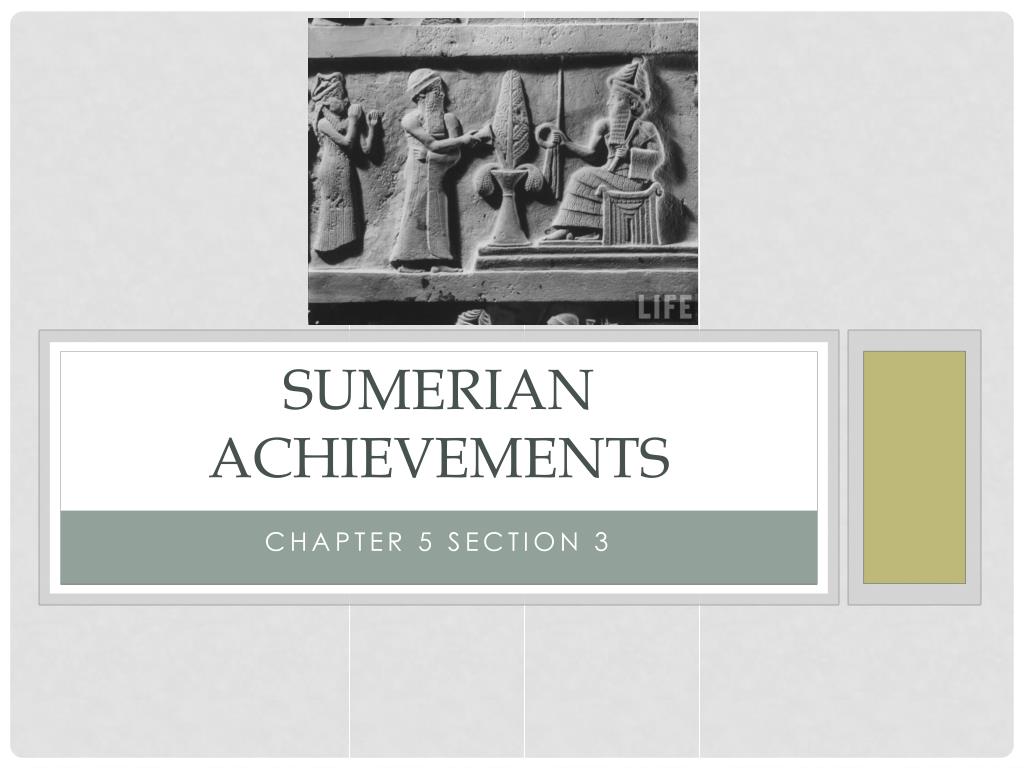
Sumerian Achievements. Chapter 5 Section 3. Main Ideas:. 1 . The Sumerians invented the world’s first writing system. 2. Advances and inventions changed Sumerian lives. 3. Many types of art developed in Sumer. Key terms:.
Sumerian Achievements - slide 1
01 / 13Sumerian Achievements
1 / 17

Télécharger la présentation

Sumerian Achievements
Une image / un lien ci-dessous est fourni (tel quel) pour télécharger la présentation

Politique de téléchargement : le contenu du site vous est fourni TEL QUEL pour votre information et votre usage personnel ; il ne peut être vendu, concédé sous licence ni partagé sur d’autres sites sans l’accord de son auteur.Le contenu vous est fourni TEL QUEL, pour votre information et votre usage personnel uniquement. Téléchargez la présentation en cliquant sur ce lien. Lors du téléchargement, si vous ne parvenez pas à télécharger une présentation, l’éditeur a peut-être supprimé le fichier de son serveur.Pendant le téléchargement, si vous ne parvenez pas à obtenir une présentation, le fichier a peut-être été supprimé par l’éditeur.

F I N

Plus de contenu associé

Transcription de la présentation
  1. Sumerian Achievements Chapter 5 Section 3

  2. Main Ideas: • 1. The Sumerians invented the world’s first writing system. • 2. Advances and inventions changed Sumerian lives. • 3. Many types of art developed in Sumer.

  3. Key terms: • Cuneiform- the Sumerian system of writing, which used symbols to represent basic parts of words • Pictographs- picture symbols that represented objects such as trees or animals • Scribe- writer • Epics- long poems that tell the story of a hero • Architecture- the science of building • Ziggurat- a pyramid-shaped temple tower

  4. Invention of writing • The Sumerians made one of the greatest cultural advances in history. • They developed cuneiform (kyoo-NEE-uh-fohrm), the world’s first system of writing. • But Sumerians did not have pencils, pens, or paper. • Instead, they used sharp reeds to make wedge-shaped symbols on clay tablets.

  5. Cuneiform (continued) • Sumerians first used cuneiform to keep records for business, government, and temples. • As the use of cuneiform grew, simple pictographs evolved into more complex symbols that represented basic parts of words. • Writing was taught in schools.

  6. Scribes and Epics • Becoming a writer, or scribe, was a way to move up in social class. • Scribes began to combine symbols to express complex ideas. • In time, scribes wrote works on law, grammar, and mathematics. • Sumerians also wrote stories, proverbs, songs, poems to celebrate military victories, and long poems called epics.

  7. Advances and inventions • The Sumerians were the first to build wheeled vehicles like carts and wagons. • They invented the potter’s wheel, a device that spins wet clay as a craftsperson shapes it into bowls. • They invented the ox-drawn plow and greatly improved farm production.

  8. Advances and inventions (continued) • The Sumerians also built sewers under city streets. • They learned to use bronze to make strong tools and weapons. • They named thousands of animals, plants, and minerals, and used them to produce healing drugs. • The clock and the calendar we use today are based on Sumerian methods of measuring time.

  9. The arts of sumer • Sumerian remains revealed great skill in architecture. • A pyramid-shaped ziggurat dominated each city. • Most people lived in one-story houses with rooms arranged around a small courtyard.

  10. Sculpture and Jewelry • Sumerian art is renowned for sculpture and jewelry. • Sculptors created statues of gods for the temples, and made small objects of ivory or rare woods.

  11. Sumerian Jewelry • Jewelers worked with imported gold, silver, and fine stones. • Sumerian jewelers knew advanced methods for putting gold pieces together.

  12. Cylinder Seals • The Sumerians also developed a special art form called the cylinder seal. • The cylinder seal was a small stone cylinder that was engraved with designs and could be rolled over wet clay to decorate containers or to “sign” documents.

  13. Sumerian music • Music played an important role in Sumerian society. • Musicians played stringed instruments, reed pipes, drums, and tambourines both for entertainment and for special occasions.