Download
1 / 11
110 likes | 234 Vues
This lesson covers key theorems that define parallelograms in quadrilaterals. Focus on Theorems 6.6 to 6.9, which establish conditions for a quadrilateral to be classified as a parallelogram. These include congruent opposite sides, congruent opposite angles, supplementary consecutive angles, and the property of diagonals bisecting each other. Engage in practice by solving for variables x and y to prove that a figure is a parallelogram. Complete assigned exercises from the textbook to reinforce understanding and application of these concepts.

E N D
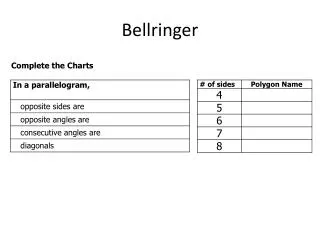
Bellringer Complete the Charts
Objectives • Show that a quadrilateral is a parallelogram
Theorems 6.6 and 6.7 • Theorem 6.6 If both pairs of opposite sides of a quadrilateral are congruent, then the quadrilateral is a parallelogram • Theorem 6.7 If both pairs of opposite angles of a quadrilateral are congruent, then the quadrilateral is a parallelogram
Theorem 6.8 • Theorem 6.8 If an angle of quadrilateral is supplementary to both of its consecutive angles, then the quadrilateral is a parallelogram
Theorem 6.9 • Theorem 6.9 If the diagonals of a quadrilateral bisect each other, then the quadrilateral is a parallelogram.
Work it • Solve for x and y so that the figure is a parallelogram
Classwork/Homework • Pg 320 #s 1-20, 28-34 all