Understanding Improper Fractions: Concepts and Conversions in Mathematics
In this guide, we explore improper fractions, where the numerator exceeds the denominator, and how to interpret them. Using examples such as 4/7 and 15/5, we'll clarify what these fractions represent and how they can be broken down. We’ll also cover how to convert improper fractions into mixed numbers and perform calculations involving remainders when the denominator does not evenly divide the numerator. Perfect for students looking to strengthen their understanding of fractions.

Understanding Improper Fractions: Concepts and Conversions in Mathematics
E N D
Presentation Transcript
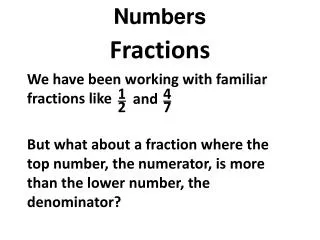
Numbers 1 2 and 4 7 Fractions We have been working with familiar fractions like But what about a fraction where the top number, the numerator, is more than the lower number, the denominator?
Numbers 15 5 This is called an Improper Fraction Fractions Take this fraction What does it mean? With the fraction 4 7 it means that there are “4 of 7”
Numbers 5+5+5 = of 5 15 5 Fractions This fraction says that there are: there are 3 lots of 5 in the 15 (3x5=15) 15 5 3 =
Numbers 18 6 3 = Fractions Lets look at a few examples to be sure we understand this: How many times does 6 go into 18? 22 11 2 = How many times does 11 go into 22?
Numbers 19 6 3 1 6 = Fractions But what happens when the denominator does not divide into the numerator evenly? How many times does 6 go into 19? How many remainders are there? 27 11 5 11 2 = How many times does 11 go into 27? How many remainders are there?
Numbers can be turned into 6ths by multiplying 3 by 6 (18) and placing this on top of 6 Fractions We have been turning Improper Fractions into Mixed Fractions. How do we do the reverse? 3 3 x 6 = 18 6
Numbers can be turned into 7ths by multiplying 2 by 7 (14) and adding this to the 3 = 3 7 2 17 7 Fractions Look at these examples: can be turned into 3rds by multiplying 4 by 3 (12) and adding this to the 2 = 2 3 4 14 3