Exploring Arena Models: A Guided Tour of Basic Operations and Simulation Techniques
Dive into the world of Arena simulation with a guided tour through various models, including a drill press system processing a single product type. Discover the significance of interarrival times and service times, and their impact on system performance. Learn about different server configurations, such as sequential and parallel servers, and examine the benefits of generalized servers in reducing work-in-progress (WIP) and waiting times. This exploration also includes insights from simulation results, emphasizing better service time variability and efficient resource management.

Exploring Arena Models: A Guided Tour of Basic Operations and Simulation Techniques
E N D
Presentation Transcript
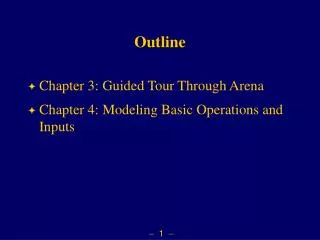
Outline • Chapter 3: Guided Tour Through Arena • Chapter 4: Modeling Basic Operations and Inputs
a drill press Model 03-01 • a drill press processing one type of product • interarrival times ~ i.i.d. exp(5) • service times ~ i.i.d. triangular (1,3,6) • all random quantities are independent one type of parts; parts come in and are processed one by one
Model 03-02 and Model 03-03 • fundamental questions • specialized or generalized workers? • effect of variability of service times? • applicant arrivals: interarrival times ~ i.i.d. exp(1.25) • four workers: all service times ~ exp(1) • Model 03-02: sequential servers • Alfie checks credit; Betty prepares covenant; Chuck prices loan; Doris disburses funds • Model 03-03: parallel servers • Each employee can do any tasks
exponential service times constant service times specialized (and sequential) servers Model 03-02 Model 03-04 generalized (and parallel) servers Model 03-03 Model 03-05 Remarks for Models 03-02 to Model 03-05 • Expression Builder & the online book (Arena Variables Guide.pdf)
Insights from Simulation Results • generalized (parallel) servers being better • less WIP; shorter total time in system; shorter total waiting time; higher throughput • less variable service times being better • less WIP; shorter total time in system; shorter total waiting time; higher throughput • formal proof after numerical evidence
Comments on Menus and Toolbars • many • menus: Edit, View, Tools, Arrange, Object, Run, Window, Help • toolbar: Standard, Draw, Animate, Integration, View, Arrange, Run Interaction, Record Macro, AVI Capture, Animate Transfer • different levels of help • specific features of Running • no animation: fast forward or batch run • compiling by clicking F4 • debugging
Chapter 4 Modeling Basic Operations & Inputs
A Sequence of Related Models • Model 4-1: a sealed electronic assembly and test system • more features, • Model 4-2: additional features in scheduling, failure, and states of resources • Model 4-3: more advanced animation • Model 4-4: advanced features in moving – stations, routes, and animation
Part A Process A EXPO(5) Tria(1,4,8) Rework 9% 91% Process B Shipped Tria(3,5,10) Part B Batches of 4 EXPO(30), de-batch on arrival An Electronic Assembly/Test System Scrapped Part A TRIA(1,3,4) Part B WEIB (2.5, 5.3) 20% 80% EXPO(45) Salvaged & Shipped Sealer
Part A Scrapped Part A TRIA(1,3,4) Part B WEIB (2.5, 5.3) Process A 20% EXPO(5) Tria(1,4,8) 80% Rework EXPO(45) Salvaged & Shipped Sealer 9% 91% Process B Shipped Tria(3,5,10) processes Part B create batches of 4 entities & de-batch later chance create entities statistics Batches of 4 EXPO(30), de-batch on arrival time varying capacity unreliable system type-dependent service times An Electronic Assembly/Test System to determine the number of racks
Model 04-01 • ignore details • the 2-minute traveling times • the working hours of stations • schedule of the re-workers • failure of the sealer • the number of racks used