Download
1 / 10
100 likes | 215 Vues
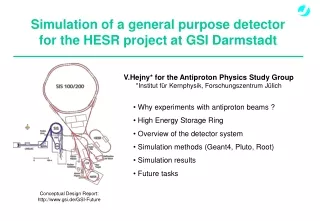
This document outlines the principles, goals, methods, and current status of simulation efforts for detector concepts at the HESR, focusing on the production of Y´(3686) in proton-proton collisions. It aims to establish a fast simulation environment for evaluating various detector configurations, performing background evaluations, and determining resolution requirements. Key methodologies include the use of ROOT and PLUTO++ frameworks, with a focus on correct kinematics and motion treatment in magnetic fields. Results highlight the expected signals and background characterizations for future experiments.

E N D
Principle Simulations for Detector Concepts at HESR • Goals • Methods • Current Status • Application to p + p Y´(3686) GSI Workshop on its Future Facility 18.10.2000 J.Ritman Uni. Gießen
Goals • Fast Simulation Environment Able to evaluate many different configurations and do multiple iterations • Correct Kinematics • Background Evaluation • Determine the required resolution and rate capabilities • Study trigger concepts (e.g. m-Cha, RICH, multiplicity jump near vertex)
Methods • ROOT as framework • PLUTO++ as event generator http://www-hades.gsi.de/computing/pluto/html/PlutoIndex.html (Marios Kagarlis) • Pseudo-Tracking • Correct treatment of motion and decays in magnetic fields. • Parameterizations of detector efficiencies and resolutions.
Results for p p Y´(3686) Background: (stot=56mb) p+p-(4 mb) p+p- + po(40 mb) p+p- + h(5 mb) p+p- + ro(15 mb) p+p- + w(60 mb) p+p- + f(10 mb) p+p- + poro(200mb) p+p- + K+K-(30 mb) p+p- + poK+K-(400mb) Signal: (235 nb) p + p Y´ e+e- (0.88%) m+m- (1.03%) J/Y p+p- (31%) J/Y2po(18.2%) J/Yh(2.7%) 2p+2p-p0 (0.35%) 2p+2p-p0 (0.3%)
Muon Phase Space Distributions Generated Y‘m+m- Detected J/Y m+m-
Expected Signal for 1 pb-1 Combinatorial background in events with Y‘ formation
Background from p and K Decay P(#m 2) ~ 0.004 (p are mostly stopped before they decay)
Kaon Identification Reaction: p(8.5GeV)+p X(M=4.4GeV) J/Y+f
Conclusions • Simulations group being formed • Fast simulation package exists • 1st iteration for HESR detector • Connection to GEANT4 being implemented (V.Hejny FZ-Jülich)