Integrated Climate Science: Advancing Research in Social Dimensions and Collaborative Solutions
This discussion focuses on the multifaceted approach to Integrated Climate Science, emphasizing collaboration across various sectors—such as agriculture, urban planning, and fisheries—along with landscapes, disciplines, and stakeholder involvement. We explore who shapes the research agenda and identify fruitful areas, such as water and climate interactions. The session will also uncover strategies for tapping into existing resources at CIMA and CONICET and how to identify opportunities for funded research through partnerships, particularly within the European Union and with CNRS and IAI expectations.

Integrated Climate Science: Advancing Research in Social Dimensions and Collaborative Solutions
E N D
Presentation Transcript
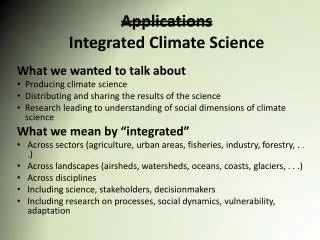
ApplicationsIntegrated Climate Science What we wanted to talk about Producing climate science Distributing and sharing the results of the science Research leading to understanding of social dimensions of climate science What we mean by “integrated” Across sectors (agriculture, urban areas, fisheries, industry, forestry, . . .) Across landscapes (airsheds, watersheds, oceans, coasts, glaciers, . . .) Across disciplines Including science, stakeholders, decisionmakers Including research on processes, social dynamics, vulnerability, adaptation
Integrated Climate Science (2) Questions asked Who defines the research agenda? The UMI. What are fruitful research areas? Water and climate interactions, e.g. How to draw on existing resources at CIMA & CONICET? Be creative and expansive. How and where to look for and find opportunities for funded research? Within CNRS; in EU context; with IAI; via research partners elsewhere. What are the expectations by CNRS, CONICET, UBA? Evaluation is unlikely to criticize research agenda or selection of topics; instead it can be expected to look at publications, funding successes, exchanges, partnerships with French researchers, training, and other measurable outputs.