Download
1 / 1
10 likes | 123 Vues
This article explores the objectives of research methods courses and dissertations in business and management education. It critiques whether these courses aim to create academic replicas or to foster 'research-mindedness'—a vital skill for future professionals, managers, and leaders. Emphasizing the importance of understanding management research's purposes, evidence bases, and evaluative criteria, the piece outlines the course structure, which includes group inquiry projects, reflection periods, and a practice-based dissertation proposal. Ultimately, it highlights the significance of cultivating awareness and sensitivity in managing complexities and dilemmas.

E N D
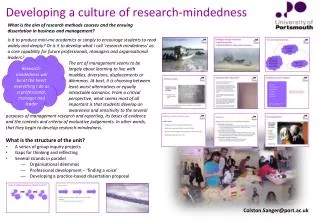
Developing a culture of research-mindedness What is the aim of research methods courses and the ensuing dissertation in business and management? Is it to produce mini-me academics or simply to encourage students to read widely and deeply? Or is it to develop what I call ‘research mindedness’ as a core capability for future professionals, managers and organisational leaders? Research- mindedness will be at the heart everything I do as a professional, manager and leader The art of management seems to be largely about learning to live with muddles, diversions, displacements or dilemmas. At best, it is choosing between least-worst alternatives or equally intractable scenarios. From a critical perspective, what seems most of all important is that students develop an awareness and sensitivity to the several purposes of management research and reporting, its bases of evidence and the contexts and criteria of evaluative judgements. In other words, that they begin to develop research-mindedness. • What is the structure of the unit? • A series of group inquiry projects • Gaps for thinking and reflecting • Several strands in parallel • Organisational dilemmas • Professional development – ‘finding a voice’ • Developing a practice-based dissertation proposal Colston.Sanger@port.ac.uk