Digital Imaging with Charge-coupled devices (CCDs)
270 likes | 391 Vues
This article explores the principles of Charge-Coupled Devices (CCDs), focusing on their capacitance and the relationship between charge and voltage. Using examples, we will calculate the charge on parallel plates, analyze pixel operation within CCDs, and demonstrate how light intensity affects electron emission and voltage generation. Key concepts include capacitance calculations, quantum efficiency, and the pixel structure responsible for light detection in technologies such as digital cameras, telescopes, and endoscopes.


Digital Imaging with Charge-coupled devices (CCDs)
E N D
Presentation Transcript
Q = CV Capacitor
Example • The capacitance of two parallel plates is 4.5pF. Calculate the charge on one plate when a voltage of 8.0 V is applied to the plates.
Example • The capacitance of two parallel plates is 4.5pF. Calculate the charge on one plate when a voltage of 8.0 V is applied to the plates. Q = CV = 4.5 x 10-12 x 8.0 = 3.6 x 10⁻¹¹ C = 36 pC
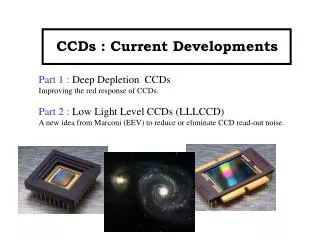
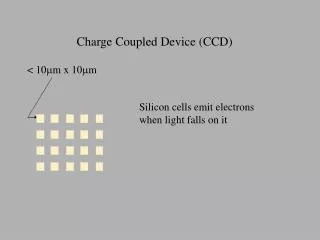
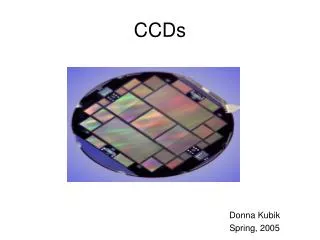
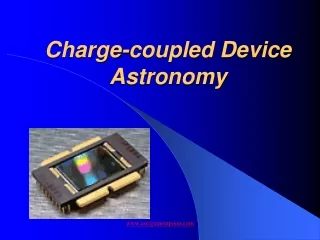
Charged-coupled device (CCD) • Silicon chip varying from 20 mm x 20 mm to 60 mm x 60 mm. • Surface covered in pixels (picture elements) varying from 5 x 10⁻⁶ m to 25 x 10-6 m.
Charged-coupled device (CCD) • Each pixel releases electrons (by the photoelectric effect) when light is incident on it. • We may think of each pixel like a small capacitor.
Charged-coupled device (CCD) • The electrons released in each pixel constitute a certain amount of charge Q, and so a potential difference V develops at the ends of the pixel (V = Q/C)
Charged-coupled device (CCD) • The number of electrons released, and the voltage created across the pixel is proportional to the intensity of light.
Charge-coupled device (CCD) • The charges on each row of pixels is pushed down to the next row until they reach the bottom row (the register)
Charge-coupled device (CCD) • The charges are the moved horizontally, where the voltage is amplified, measured, and and passed to a digital converter.
Charge-coupled device (CCD) • The computer processing this information now knows the position and voltage on each pixel. • The light intensity is proportional to the voltage so a digital (black and white image) is now stored.
Charge-coupled device (CCD) • To store a colored image, the pixels are arranged in groups of four, with 2 green filters, a red and a blue.
Quantum efficiency • The ratio of the number of emitted electrons to the number of incident photons. • About 70% for a CCD (4% for photographic film and 1% for the human eye.
Example • The area of a pixel on a CCD is 8.0 x 10⁻¹⁰ m2 and its capacitance is 38 pF. Light of intensity 2.1 x 10⁻³ W.m-2 and wavelength 4.8 x 10⁻⁷ m is incident on the collecting area of the CCD for 120 ms. Calculate the p.d. across the pixel, assuming that 70% of the incident photons cause the emission of an electron.
Example • The area of a pixel on a CCD is 8.0 x 10⁻¹⁰ m2 and its capacitance is 38 pF. Light of intensity 2.1 x 10⁻³ W.m-2 and wavelength 4.8 x 10⁻⁷ m is incident on the collecting area of the CCD for 120 ms. Calculate the p.d. across the pixel, assuming that 70% of the incident photons cause the emission of an electron. The energy incident on a pixel = 2.1 x 10-3 x 8.0 x 10-10 x 120 x 10-3 = 2.0 x 10⁻¹³ J
Example • The area of a pixel on a CCD is 8.0 x 10⁻¹⁰ m2 and its capacitance is 38 pF. Light of intensity 2.1 x 10⁻³ W.m-2 and wavelength 4.8 x 10⁻⁷ m is incident on the collecting area of the CCD for 120 ms. Calculate the p.d. across the pixel, assuming that 70% of the incident photons cause the emission of an electron. The energy incident on a pixel = 2.1 x 10-3 x 8.0 x 10-10 x 120 x 10-3 = 2.0 x 10⁻¹³ J The energy of one photon = hf = hc/λ = (6.63 x 10-34 x 3.0 x 108)/4.8 x 10-7 = 4.1 x 10⁻¹⁹ J
Example • The area of a pixel on a CCD is 8.0 x 10⁻¹⁰ m2 and its capacitance is 38 pF. Light of intensity 2.1 x 10⁻³ W.m-2 and wavelength 4.8 x 10⁻⁷ m is incident on the collecting area of the CCD for 120 ms. Calculate the p.d. across the pixel, assuming that 70% of the incident photons cause the emission of an electron. The energy incident on a pixel = 2.0 x 10⁻¹³ J The energy of one photon = 4.1 x 10⁻¹⁹ J The number of incident photons is then = 2.0 x 10⁻¹³ / 4.1 x 10-19 = 4.9 x 10⁵
Example • The area of a pixel on a CCD is 8.0 x 10⁻¹⁰ m2 and its capacitance is 38 pF. Light of intensity 2.1 x 10⁻³ W.m-2 and wavelength 4.8 x 10⁻⁷ m is incident on the collecting area of the CCD for 120 ms. Calculate the p.d. across the pixel, assuming that 70% of the incident photons cause the emission of an electron. The number of incident photons is then = 2.0 x 10⁻¹³ / 4.1 x 10-19 = 4.9 x 10⁵ The number of absorbed photons is therefore = 0.70 x 4.9 x 105 = 3.4 x 10⁵
Example • The area of a pixel on a CCD is 8.0 x 10⁻¹⁰ m2 and its capacitance is 38 pF. Light of intensity 2.1 x 10⁻³ W.m-2 and wavelength 4.8 x 10⁻⁷ m is incident on the collecting area of the CCD for 120 ms. Calculate the p.d. across the pixel, assuming that 70% of the incident photons cause the emission of an electron. The number of absorbed photons is therefore = 0.70 x 4.9 x 105 = 3.4 x 10⁵ The charge corresponding to this number of electrons is 3.4 x 105 x 1.6 x 10-19 = 5.4 x 10⁻¹⁴ C
Example • The area of a pixel on a CCD is 8.0 x 10⁻¹⁰ m2 and its capacitance is 38 pF. Light of intensity 2.1 x 10⁻³ W.m-2 and wavelength 4.8 x 10⁻⁷ m is incident on the collecting area of the CCD for 120 ms. Calculate the p.d. across the pixel, assuming that 70% of the incident photons cause the emission of an electron. The charge corresponding to this number of electrons is 3.4 x 105 x 1.6 x 10-19 = 5.4 x 10⁻¹⁴ C The p.d. is thus V = Q/C = 5.4 x 10⁻¹⁴/38 x 10-12 = 1.4 mV
Resolution • Two points are resolved if their images are more than two pixel lengths apart.