Evidence for Evolution: Fossils, Structures, and Biochemical Insights
Evolution is substantiated through various forms of evidence. Fossils serve as preserved remains, revealing the history of life on Earth, and can be dated using relative and radiometric methods. Homologous structures in vertebrates showcase a shared ancestry despite differing functions. Vestigial organs, such as whale bones and the human tailbone, signify evolutionary remnants. Embryology provides early stages that hint at common ancestry, featuring pharyngeal pouches and limb buds. Additionally, comparative biochemistry, including DNA and key biomolecules, illustrates evolutionary connections among all forms of life.


Evidence for Evolution: Fossils, Structures, and Biochemical Insights
E N D
Presentation Transcript
EVIDENCE OF EVOLUTION
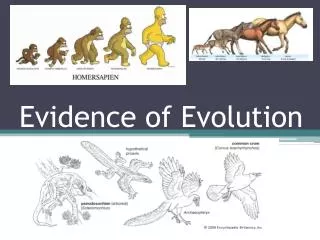
Evidence for evolution exists in the following: Fossils Homologous structures Vestigial organs Embryology Comparative biochemistry
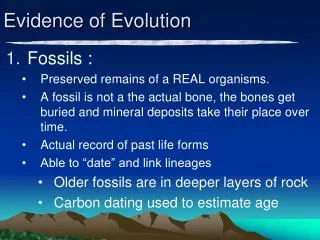
1. Fossils – preserved remains of organisms. • May be : Imprint Mold Petrified Amber
Fossils are a record of living organisms. • Fossil evidence cannot be disputed. • Fossils are found in sedimentary rock. • Fossils are dated by two methods: • 1. Relative dating – estimated date of fossil according to rock layer in which the fossil • was found. • 2. Radiometric dating – more exact date based on the rate at which radioactive material in the rock decays.
Homologous Structures • Found in vertebrates. • Similar bone patterns that suggest common ancestry. • Function of the structure may or may not be the same. Grasp Climb Fly Swim Run
Vestigial Organs • Structures that no longer have a function and are therefore • disappearing. IE. “Use it or Lose it”. • Ex. 1 – Whale feet • Remnants of feet remain on the • whale skeleton from when the • ancestors of whales walked on land. Ex. 2 – Human tail bone (coccyx)
Embryology • Early stages of embryonic development in a variety of organisms • that suggests common ancestry. • All have: • *Pharyngeal pouch which • become gills in fish & • amphibians. • *Tail • *Buds that become limbs. As organisms grow & develop, new instructions are layered on old ones. Tail and gills become relics and disappear in humans.
Comparative Biochemistry • DNA – only 4 nitrogen bases in all forms of life. • - structure of double helix. • - record of evolution. • Key molecules such as enzymes and hemoglobin. • Like processes such as respiration, glycolysis, photosynthesis