Understanding Nuclear Reactions: Types, Decay, and Energy Production
This chapter explores the fundamentals of nuclear energy, focusing on various types of nuclear reactions including alpha, beta, and gamma radiation. It highlights processes like nuclear decay, transmutation, fission, and fusion—explaining how fission splits nuclei to release energy, while fusion combines nuclei, producing even greater energy output. Additionally, it emphasizes the Law of Conservation of Mass, ensuring that nuclear equations adhere to the principle that reactant masses equal product masses. A comprehensive overview for students studying nuclear physics and energy.

Understanding Nuclear Reactions: Types, Decay, and Energy Production
E N D
Presentation Transcript
CHAPTER24 Nuclear Energy II. Nuclear Reactions (p.689-691)
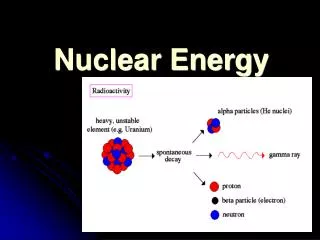
A. Types of Radiation • Alpha () • helium nucleus paper 2+ • Beta-minus (-) • electron lead 1- • Gamma () • high-energy photon concrete 0
B. Nuclear Decay TRANSMUTATION • Alpha Emission • Beta Emission
C. Fission • splitting a nucleus into two or more smaller nuclei • some mass is converted to large amounts of energy
C. Fission • chain reaction - self-feeding reaction
D. Fusion • combining of two nuclei to form one nucleus of larger mass • produces even more energy than fission • occurs naturally in stars
E. Law of Conservation Of Mass • ALL NUCLEAR EQUATIONS MUST FOLLOW THE LAW OF CONSERVATION OF MASS. • The masses on the reactants must equal the masses on the products.