
SlideServe
Menu
Préférences
© SlideServe · v2026

Work Done by a System

miya avatar
11 diapositives · 701 Views · Sep 19, 2014

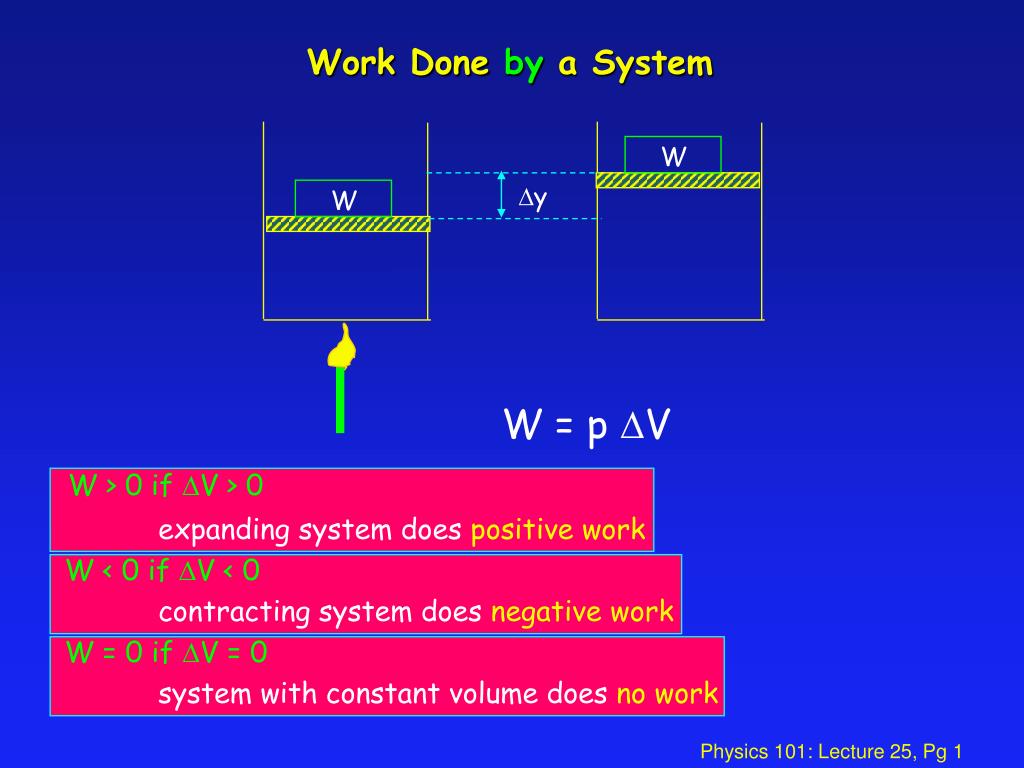
y. W. W. Work Done by a System. W = p V W > 0 if V > 0 expanding system does positive work W < 0 if V < 0 contracting system does negative work W = 0 if V = 0 system with constant volume does no work. Homework Problem: Thermo I. 1. P. 2. 4. 3. P. P. W = P D V (>0).
Work Done by a System - slide 1
01 / 11Work Done by a System
1 / 17

Télécharger la présentation

Work Done by a System
Une image / un lien ci-dessous est fourni (tel quel) pour télécharger la présentation

Politique de téléchargement : le contenu du site vous est fourni TEL QUEL pour votre information et votre usage personnel ; il ne peut être vendu, concédé sous licence ni partagé sur d’autres sites sans l’accord de son auteur.Le contenu vous est fourni TEL QUEL, pour votre information et votre usage personnel uniquement. Téléchargez la présentation en cliquant sur ce lien. Lors du téléchargement, si vous ne parvenez pas à télécharger une présentation, l’éditeur a peut-être supprimé le fichier de son serveur.Pendant le téléchargement, si vous ne parvenez pas à obtenir une présentation, le fichier a peut-être été supprimé par l’éditeur.

F I N

Plus de contenu associé

Transcription de la présentation
  1. y W W Work Done by a System • W = p V • W > 0 if V > 0 • expanding system doespositivework • W < 0 if V < 0 • contracting system doesnegativework • W = 0 if V = 0 • system with constant volume doesnowork

  2. Homework Problem: Thermo I 1 P 2 4 3 P P W = PDV (>0) W = PDV = 0 V 1 1 2 2 1 P 2 4 4 3 3 Wtot > 0 4 3 DV > 0 V DV = 0 V V P P W = PDV (<0) W = PDV = 0 1 1 2 2 1 P 2 If we gothe other way thenWtot < 0 4 4 3 3 4 3 V DV = 0 V DV < 0 V Wtot = ??

  3. Now try this: P 1 P1 P3 2 Area = (V2-V1)x(P1-P3)/2 3 V V1 V2

  4. P Work done by system 1 P1 P3 2 3 V V1 V2 First Law of ThermodynamicsEnergy Conservation DU = Q- W Increase in internalenergy of system Heat flow into system Equivalent ways of writing 1st Law: Q = DU + W Q = DU + p DV

  5. P 1 P 2 V V1 V2 First Law of ThermodynamicsExample 2 moles of monatomic ideal gas is taken from state 1 to state 2 at constant pressure p=1000 Pa, where V1 =2m3 and V2 =3m3. Find T1, T2, DU, W, Q. 1. pV1 = nRT1 T1 = pV1/nR = 120K 2. pV2 = nRT2 T2 = pV2/nR = 180K 3. DU = (3/2) nR DT = 1500 J DU = (3/2) p DV = 1500 J (has to be the same) 4. W = p DV = 1000 J 5. Q = DU + W = 1500 + 1000 = 2500 J

  6. First Law of ThermodynamicsExample 2 moles of monatomic ideal gas is taken from state 1 to state 2 at constant volume V=2m3, where T1=120K and T2 =180K. Find Q. P P2 P1 2 1. pV1 = nRT1 p1 = nRT1/V = 1000 Pa 2. pV2 = nRT1 p2 = nRT2/V = 1500 Pa 3. DU = (3/2) nR DT = 1500 J 4. W = p DV = 0 J 5. Q = DU + W = 0 + 1500 = 1500 J requires less heat to raise T at const. volume than at const. pressure 1 V V

  7. P(atm) P(atm) A B 4 4 A B 2 2 Case 1 Case 2 correct 3 9 3 9 V(m3) V(m3) Chapter 15,Problem 1 Shown in the picture below are the pressure versus volume graphs for two thermal processes, in each case moving a system from state A to state B along the straight line shown. In which case is the work done by the system the biggest? 1. Case 1 2. Case 2 3. Same Net Work = area under P-V curve Area the same in both cases!

  8. P(atm) P(atm) A B 4 4 A B 2 2 Case 1 Case 2 correct 3 9 3 9 V(m3) V(m3) Chapter 15,Problem 2 Shown in the picture below are the pressure versus volume graphs for two thermal processes, in each case moving a system from state A to state B along the straight line shown. In which case is the change in internal energy of the system the biggest? 1. Case 1 2. Case 2 3. Same U = 3/2 (pV) Case 1: (pV) = 4x9-2x3=30 atm-m3 Case 2: (pV) = 2x9-4x3= 6 atm-m3

  9. P(atm) P(atm) A B 4 4 A B 2 2 Case 1 Case 2 correct 3 9 3 9 V(m3) V(m3) Chapter 15,Problem 2 (followup) Shown in the picture below are the pressure versus volume graphs for two thermal processes, in each case moving a system from state A to state B along the straight line shown. In which case is the heat added to the system the biggest? 1. Case 1 2. Case 2 3. Same Q = U + W W is same for both U is larger for Case 1 Therefore, Q is larger for Case 1

  10. P Work done by system 1 P1 P3 2 Q= DU + W Increase in internalenergy of system 3 Heat flow into system V V1 V2 Some questions: • Which part of cycle has largest change in internal energy, DU ? • 2  3 (since U = 3/2 pV) • Which part of cycle involves the least work W ? • 3  1 (since W = pDV) • What is change in internal energy for full cycle? • U = 0 for closed cycle (since both p & V are back where they started) • What is net heat into system for full cycle? • U = 0  Q = W = area of triangle (>0)

  11. Work done by system Increase in internalenergy of system Heat flow into system Recap: • 1st Law of Thermodynamics: Energy Conservation Q= DU + W P • point on p-V plot completely specifies state of system (pV = nRT) • work done is area under curve • U depends only on T (U = 3nRT/2 = 3pV/2) • for a complete cycle DU=0  Q=W V