Download
1 / 17
190 likes | 311 Vues
This overview highlights the evolution of classification in biology from Aristotle's early categorization of animals and plants based on movement and size to John Ray's systematic approach for England in the 17th century, emphasizing anatomy and the concept of "species." It further explores Carolus Linnaeus's contributions in the 18th century, introducing binomial nomenclature as a universal naming system. The text discusses taxonomy's role in organizing organisms by shared traits and biological relationships, how evolution impacts classification, and the importance of both physical and genetic evidence in understanding life's diversity.

E N D
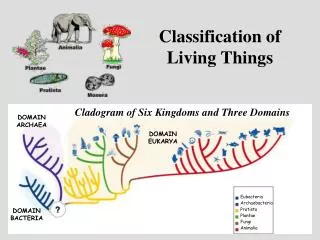
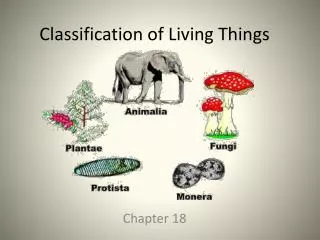
Classificationof Living Things Introduction
Aristotle • Greek • 4th Century BC • Animals by movement • Plants by size
John Ray • English • 17th century • Goal was to collect, name, classify all plants and animals in England • Used internal anatomy • First to use the word “species”
Carolus Linnaeus • Swedish • 18th century • Used similarities in structure • Invented a 2 word naming system (binomial nomenclature) Genus species
Modern System • Groups according to basic traits • Gives a unique name to every kind of living thing • Name is used universally (Latin or Greek)
Common names can be misleading • Starfish • Puma, cougar, mountain lion
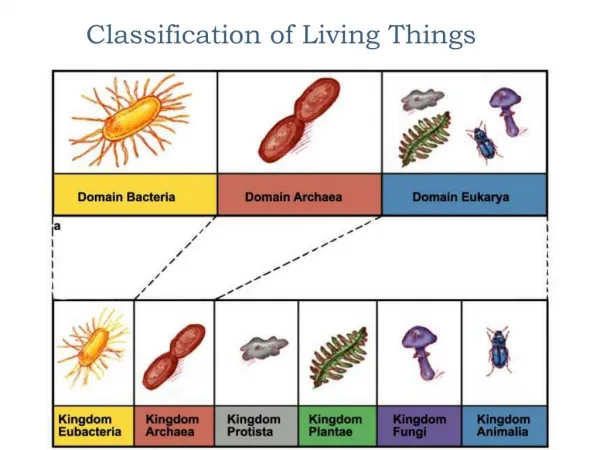
Classification • Process of grouping organisms based on similarities
Taxonomy • Science of naming and classifying organisms • Naming of organisms should reflect the traits of the organisms
The more characteristics two organisms share, the more closely related they are • If 2 organisms share the same trait, they could share the same ancestor
Biological Relationships • Living things evolve over time • Scientists try to discover how one species evolved as compared with another • Species that share ancestors are grouped together.
Biological Relationships • Scientists compare a variety of traits • Size • Bone structure • Body shape
Animal Algae Sargassum Fish Sargassum Seaweed Fronds Fish with Leafy fronds Same body shape Sea Horse Sea Dragon
Physical Evidence • Early scientists used their eyes and measuring devices as tools to compare • Noted color, size, weight, how energy is obtained • Later they used internal structure and appearance • Used fossils to compare species of past with those of today
Physical Evidence • Fossils can tell how extinct organisms moved, lived, ate. • Physical evidence shows that all organisms are related by evolution.
Lives west of Rockies • Solid black head • No white feathers CyanocittastelleriCyanocittacristata • Lives east of Rockies • Blue, black, and white head
Genetic Evidence • DNA and computers can be used to compare components of one organism with another. • Genetic evidence usually supports physical evidence, but not always.