Mastering Wave Speed Equations: A Comprehensive Guide
100 likes | 298 Vues
Learn to calculate wave speed using the universal wave equation. Understand the factors influencing wave speed, such as temperature and linear density. Examples and quizzes included!


Mastering Wave Speed Equations: A Comprehensive Guide
E N D
Presentation Transcript
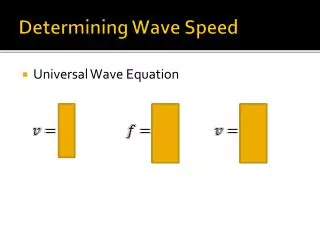
The Universal Wave Equation Recall: to find speed, v = d t For a wave, d = length of wave, λ t = time for one cycle, T v = λ or v = λf (since 1/T = f) T
Things to Note: • One vibration/cycle of the source → one complete wavelength. • the frequency of the source = The frequency of the wave • If the frequency of the source never changes then the frequency of the wave doesn’t either, even if the speed and wavelength change. • Speed and wavelength can change due to a medium change
Example 1 The wavelength of a water wave in a ripple tank is 0.080 m. If the frequency of the wave is 2.5 Hz, what is its speed?
Example 2 The period of a sound wave from a piano is 1.18 x 10⁻³ s. If the speed of the wave in the air is 3.4 x 10² m/s, what is its wavelength?
Factors That Affect Wave Speed Temperature • In gases, higher temp = more efficient transfer of energy because molecules are vibrating faster Linear Density • Mass/unit of distance → determines amount of force needed to make string vibrate µ = m m – mass (kg) L L – length (m)
Example 3 If a string on a wave machine has a linear density of 0.011 kg/m and a tension of 250 N, what is the wave speed?
Example 4 If a 2.5 m long string on the same wave machine has a tension of 240 N, and the wave speed is 300 m/s, what is the mass of the string?
Homework pg 391 #1- 7 Quiz on Wednesday