
Course Content
E N D
Presentation Transcript
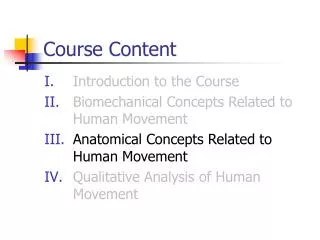
Course Content • Introduction to the Course • Biomechanical Concepts Related to Human Movement • Anatomical Concepts Related to Human Movement • Qualitative Analysis of Human Movement
Anatomical Concepts Related to Human Movement • The Skeletal System • The Muscular System • The Nervous System
The Muscular System • Organ Level Structure & Function • System Level Structure & Function • Injury to the Musculoskeletal System
The Muscular System • Organ Level Structure & Function • System Level Structure & Function • Injury to the Skeletal System • Musculoskeletal Function
General Structure • ~ 434 muscles • 40%-45% of body weight • 75 pairs of muscles • Organized into compartments • Utilizes 50% of body’s metabolism • Controlled by somatic nervous system
General Function • Provides force/torque for movement • Maintenance of upright posture • Body transport • Object manipulation • Aids in venous return • Maintains body temperature
Organ Level Structure and Function • Structure of the Muscle Organ • Function of the Muscle Organ
Organ Level Structure and Function • Structure of the Muscle Organ • Function of the Muscle Organ
Muscle Tissue – Active Component
Properties of Skeletal Muscle Tissue • Excitability (Irritability) • Conductivity • Contractility • Extensibility • Elasticity
Connective Tissue – Passive Component
Nerve Tissue – Passive Component
Structure of the Muscle Organ • Muscle organ: 40,000 -1,000,000 fibers • Fascicle: 10-200 fibers • Fiber: 8000 fibrils
Organ Level Structure and Function • Structure of the Muscle Organ • Function of the Muscle Organ
Function of the Muscle Organ Force Production
Factors That Affect Force Output • Physiological factors • Cross-sectional area • Fiber type • Neural factors • Muscle fiber activation • Rate of motor unit activation • Biomechanical factors • Muscle architecture • Force-length relationship • Force-velocity relationship
Physiological Factors: CSA Training?
Physiological Factors: Muscle Fiber Type • Type I • Red, SO, slow-twitch • Type IIa • Red, FOG, fast-twitch, intermediate • Type IIb • White, FG, fast-twitch Training??
Factors That Affect Force Output • Physiological factors • Cross-sectional area • Fiber type • Neural factors • Muscle fiber activation • Rate of motor unit activation • Biomechanical factors • Muscle architecture • Force-length relationship • Force-velocity relationship
Neurological Factors: Muscle Fiber Activation • All-or-None Principle • Same fiber type within MU • 10-2000 fibers per MU • 120-580 MUs / muscle • MU size influences precision & force of movement
Neurological Factors: Muscle Fiber Activation • # of activated MUs, force • Training?
Neurological Factors: Rate of Motor Unit Activation • rate of MU activation, force
Single Twitch Multiple Twitch Tetanus Training??
Factors That Affect Force Output • Physiological factors • Cross-sectional area • Fiber type • Neural factors • Muscle fiber activation • Rate of motor unit activation • Biomechanical factors • Muscle architecture • Force-length relationship • Force-velocity relationship
Nonpennate Muscle Pennate Muscle
Ranges of Muscle Pennation in Humans (Yamaguchi et al., 1990)
Nonpennate Muscle Pennate Muscle
Biomechanical Factors: Muscle Architecture • Pennate • Greater force (force ~ PCSA) • Non-pennate • Greater range of muscle lengths • Larger ROM • Greater operating range • Shorten at higher velocities • Training?
Factors That Affect Force Output • Physiological factors • Cross-sectional area • Fiber type • Neurological factors • Muscle fiber activation • Rate of motor unit activation • Biomechanical factors • Muscle architecture • Force-length relationship • Force-velocity relationship
60% 160% Single Joint Muscles 110-120%
Multi Joint Muscles >160% 60%
Factors That Affect Force Output • Physiological factors • Cross-sectional area • Fiber type • Neurological factors • Muscle fiber activation • Rate of motor unit activation • Biomechanical factors • Muscle architecture • Force-length relationship • Force-velocity relationship
110-180% isometric Biomechanical Factors: Force-Velocity Relationship Eccentric Concentric Velocity
Factors that Affect Force Output • Physiological factors • Cross-sectional area • Fiber type • Neurological factors • Muscle fiber activation • Rate of motor unit activation • Biomechanical factors • Muscle architecture • Length-tension relationship • Force-velocity relationship
Summary • Numerous factors affect the force output of the muscle organ. • Identification of these factors allows us to better understand muscle strength and explore alternative training methods that may be effective in increasing muscle strength.