
Properties and Changes of Matter
E N D
Presentation Transcript
mATTER Anything that has mass and volume (takes up space) Exists usually as a solid, liquid or gas (the fourth state is plasma)
Characteristics (Properties) of Matter • Matter has many characteristics (properties) that can be observed: • Physical (observed without changing the make up of the substance) • Mass • Volume • Density • Color • Shape/size • Texture
More Physical Properties • Conductor of electricity • Hardness of a mineral • Streak of a mineral • Cleavage of a mineral • Odor • Melting/freezing/boiling point • Solubility
Physical Changes • A change in a physical property without changing the make up of the substance • Examples include: • Ripping paper • Cutting a piece of yarn • Stretching a rubber band • Phase changes (water boiling, freezing and melting) • Sheep-sheering • Separating a mixture (by physical means)
Characteristics of Physical Changes • The substance is the SAME before and after • Only the physical properties change • A physical change CAN be reversed
Chemical Changes • Matter has many characteristics (properties) that can be observed: • Chemical (describe how substances can form new substances) • Combustibility • Ability to rust • Tarnishing • pH
Chemical Changes • A change in a substance that produces one or more new substances • Examples include • Nail rusting • Wood burning • Food cooking • Tarnishing of the Statue of Liberty • Photosynthesis
Evidence of a Chemical Change Look for: • color change • bubbling and fizzing (a gas is produced) • light or heat production (the release of energy) • formation of a solid.
Characteristics of Chemical Changes • Substance changes into something else (it is NOT the same before and after) • Both physical and chemical properties change • A chemical change can NOT be reversed
SOOOOOOOO…… WHERE DO WE BEGIN!?!?!?
Mass • The amount of matter an object contains • Measured with a triple beam balance • Unit (symbol) • Gram (g)
Volume • Amount of space a substance takes up
Density • A property of matter representing the mass per unit volume • D= m/v • Unit (symbol) • g/cm3 or g/mL • “how jam-packed something is” NOT how light or heavy something is!
Solubility • A substance’s ability to dissolve • Insoluble means does not dissolve Ex: Hot cocoa mix in milk or water Iced tea mix in water You can speed up the rate at which a substance dissolves by: • Stirring • Increasing surface area (cutting into smaller pieces) • Adding heat
Solubility Words • Solute- in a solution, a substance that is dissolved into a solvent • Ex) iced tea mix, hot cocoa mix, chocolate syrup • Solvent- in a solution, a substance that dissolves a solute, present in the largest percentage • Ex) water, when making iced tea there is more water than iced tea mix • Solution- a mixture of two or more substances that is identical throughout
More Solubility Words • Saturated - containing the maximum amount of a solute that can be dissolved (there’s no room) • Unsaturated - not saturated, there’s still room • Super-saturated - there’s extra at the bottom • Concentration - solute / solvent • More solute = more concentrated = “stronger” • Less solute = less concentrated = “weaker” (diluted)
Solubility Curves • Look at the graph and describe the lines! • Some increase, • some decrease, • some slowly, • some quickly. • It doesn’t matter what the substance is….just how the line looks!
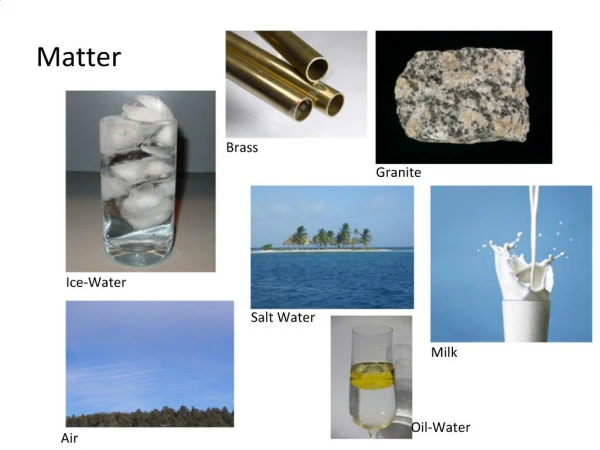
Matter can be pure or mixed • Matter can be a pure substance, meaning it only has one type of component: • Examples: • Elements • Contains only one type of atom • Gold contains gold atoms • Compounds Contains two or more types of atoms bonded together • Compounds have very different properties than the elements that make them up • Ex) Na (explosive) and Cl (poisonous gas) when mixed, make table salt
Matter can be pure or mixed • Mixtures are combinations of substances in which the substance retains its properties • M&Ms ~ the red M&M still stays red even though it’s mixed with green and yellow M&Ms • Fruit salad ~ all the fruit pieces remain as the individual fruit
Separating Mixtures • Can be separated by physical means • Color, size, shape, texture • Using a magnet (if one part is magnetic) • Strainer if mixed in water/other liquid • If dissolved in water, evaporate the water