SlideServe
Menu
Préférences
© SlideServe · v2026

Engine Basics for Beginners

mnadel avatar
16 diapositives · 290 Views · Jan 06, 2020

Learn about the cylinder block, piston configurations, crankshaft, stroke cycles, ignition types, and more in this comprehensive guide to how engines work.
Engine Basics for Beginners - slide 1
01 / 16Engine Basics for Beginners
1 / 17

Télécharger la présentation

Engine Basics for Beginners
Une image / un lien ci-dessous est fourni (tel quel) pour télécharger la présentation

Politique de téléchargement : le contenu du site vous est fourni TEL QUEL pour votre information et votre usage personnel ; il ne peut être vendu, concédé sous licence ni partagé sur d’autres sites sans l’accord de son auteur.Le contenu vous est fourni TEL QUEL, pour votre information et votre usage personnel uniquement. Téléchargez la présentation en cliquant sur ce lien. Lors du téléchargement, si vous ne parvenez pas à télécharger une présentation, l’éditeur a peut-être supprimé le fichier de son serveur.Pendant le téléchargement, si vous ne parvenez pas à obtenir une présentation, le fichier a peut-être été supprimé par l’éditeur.

F I N

Plus de contenu associé

Transcription de la présentation
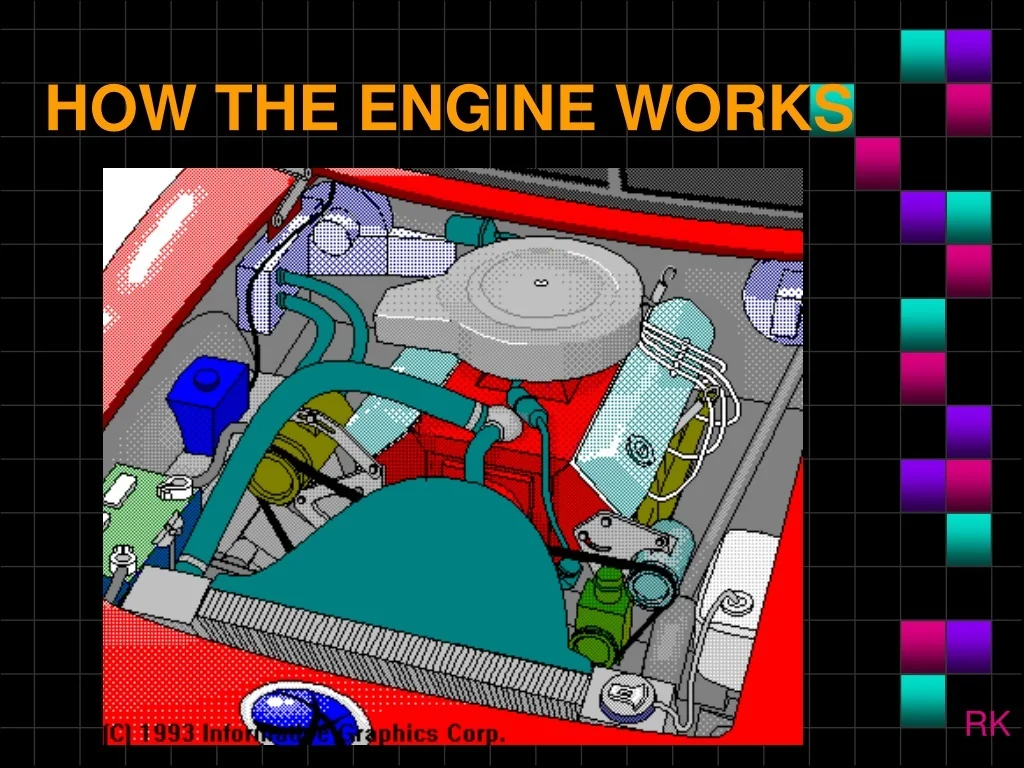
  1. HOW THE ENGINE WORKS RK

  2. CYLINDER BLOCK • The cylinder block is the foundation to which all other components are attached. RK

  3. PISTON and ROD • Cast Piston • Forged Piston • Barrel Skirt • Slipper Skirt • Two compression rings • One oil ring RK

  4. CRANKSHAFT • Changes Recipro-cating motion to Rotating motion RK

  5. PISTON CONFIGURATIONS • Inline 6 • Inline 4 • Opposed 4 • V-6 • V-8 RK

  6. OTHER ENGINE ID’S • Valve Train Type • Flathead • Overhead Valve (OHV) • Overhead Cam (OHC) or (SOHC) • Dual Overhead Cam (DOHC) • Engine Displacement • Know conversion Factors From CI to CC • CC to CI RK

  7. TDC Top Dead Center Piston at top of stroke. BDC Bottom Dead Center Piston at Bottom of stroke. STROKE TDC to BDC BDC to TDC 180 degrees of crankshaft rotation FOUR CYCLE (Stroke) 4 x 180 = 720 degrees to make one complete cycle. DEFINITIONS RK

  8. FOUR STROKE CYCLE • Intake Compression • Power • Exhaust RK

  9. IGNITION • Spark Ignition (SI) • Gasoline Engines use a precisely timed electric spark to start the combustion process. • Compression Ignition (CI) • Diesel Engines use the heat produced from compression to raise cylinder temperature above the flash point of diesel, and inject fuel directly into the cylinder.

  10. CAMSHAFTS • Camshafts turn at one half crankshaft speed. • Camshafts can be driven with a gear, chain and sprocket, or toothed belt. • Camshafts have one lobe for each valve. RK

  11. INTAKE STROKE • Intake valve open • Exhaust valve closed • piston traveling down from TDC to BDC • Air is being force into the cylinder by the difference between atmospheric and cylinder pressure RK

  12. VACUUM DEFINITION • Any pressure less than atmospheric in a sealed or semi-sealed container • Approximately 14.7 PSI at sea level RK

  13. COMPRESSIONSTROKE • Both valves closed • Piston traveling up BDC to TDC • Compressing the air-fuel mixture RK

  14. POWERSTROKE • Both valves closed • Spark plug ignites the air fuel mixture • Piston is being pushed down by the expanding gases from TDC to BDC RK

  15. EXHAUSTSTROKE • Exhaust valve open • Intake valve closed • Piston traveling up from BDC to TDC forcing the burnt exhaust gases from the cylinder RK

  16. At TDC the engine has returned to its starting point. RK