Exploring Higher Derivatives in Calculus: A Geometric Approach
60 likes | 181 Vues
This resource delves into the application of higher derivatives in calculus, specifically focusing on the differentiation of the polynomial function f(x) = x³ - 4x² + 3x - 2. We find the first four derivatives, demonstrating the process and revealing crucial calculus rules, including the Power Rule, Product Rule, and Quotient Rule. By applying these rules, learners can better understand how derivatives transform geometrically, enhancing their ability to analyze functions and their properties.


Exploring Higher Derivatives in Calculus: A Geometric Approach
E N D
Presentation Transcript
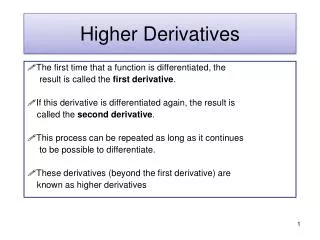
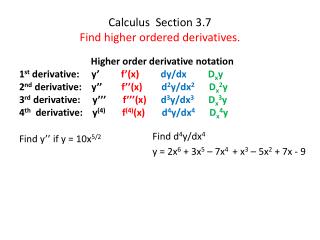
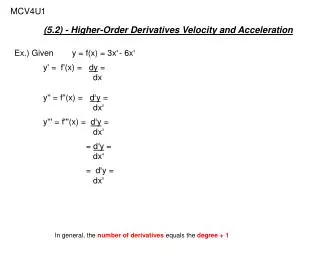
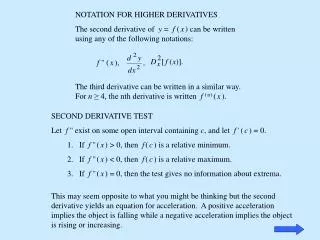
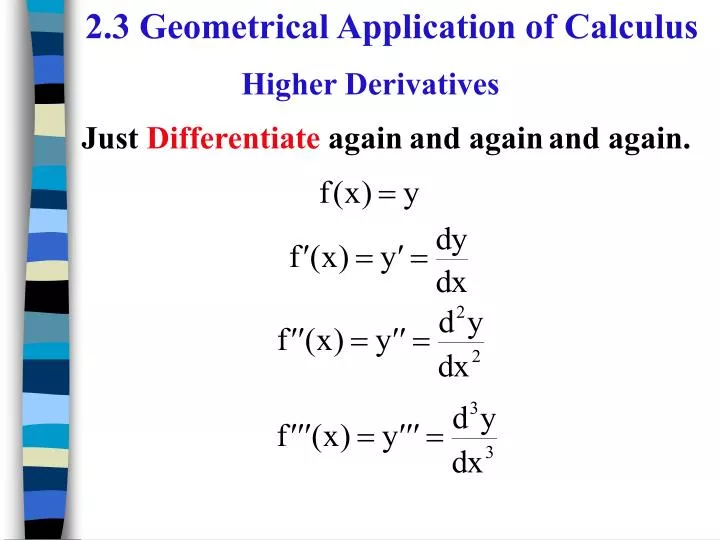
2.3 Geometrical Application of Calculus Higher Derivatives Just Differentiate again and again and again.
2.3 Geometrical Application of Calculus 1. Find the first 4 derivatives of f(x) = x3 - 4x2 + 3x -2 f’(x) = 3x2 - 8x+3 f’’(x) = 6x - 8 f’’’(x) = 6 f’’’’(x) = 0
2.3 Geometrical Application of Calculus Rules for Differentiation If f(x) = xnthen … f’(x) = nxn-1 and If f(x) = axnthen … f’(x) = anxn-1
2.3 Geometrical Application of Calculus Rules for Differentiation Function of a Function Rule If y = (u)nthen … or
2.3 Geometrical Application of Calculus Rules for Differentiation Product Rule If y = uvthen …
2.3 Geometrical Application of Calculus Rules for Differentiation Quotient Rule If y = uthen … v