An Overview of Modeling and Simulation Processes in Decision Making
This chapter discusses the systematic approach to modeling and simulation processes, focusing on problem formulation, model specification, model building, simulation execution, and usage in decision-making. Key steps include defining objectives, measuring system performance, and iteratively refining models based on statistical analysis and graphical representations. It highlights how tools like AweSim and Visual SLAM can enhance simulation efforts in various industries, including manufacturing and healthcare. The importance of documenting and interpreting simulation results for effective decision support is emphasized.

An Overview of Modeling and Simulation Processes in Decision Making
E N D
Presentation Transcript
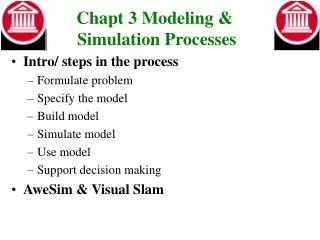
Chapt 3 Modeling & Simulation Processes • Intro/ steps in the process • Formulate problem • Specify the model • Build model • Simulate model • Use model • Support decision making • AweSim & Visual Slam
Formulate Problem Specify Model Build Model Simulate Model Use Model Support Decision Making Modeling & Simulation Processes • Use an iterative process where relationships & parameters are continually redefined & improved.
Formulate the Problem Focuses the modeling/ simulation efforts 1) Identify the Goal 2) Specify the system performance measures 3) Set objectives 4)Completely define the systems to be modeled
Formulate the Problem • Goals • specify what is to be achieved ie lower cycle time by capital investing • Performance measures • Measurable outputs ie profits/costs, inventory levels, speed, % waiting time • Objectives • More specific, ie reduce queue/bottle neck for process or provide redundant machine for maintenance/ redundancy • Complete definition • Scope and boundary definitions
Specify Model • Define system but w/o unnecessary detail • Easily understood but realistic • Reasonable simplifying assumptions • Include interactions of activities • Conceptualize data requirements • collected • use statistical methods
Build Model • Develop Simulation model • Interactive & Iterative- continually redefined, updated, modified & extended • Collect data • Time studies, accessing data bases, statistical • Define Experimental Controls • Number of sim runs, report types/ plots/ histograms, status of specific variables ie idle/busy • All steps are interdependent
Simulate Model • Run Model • Simulation advances time in accordance with the movement of entities thru nodes and activities • Verify Model • Does the model behave as expected ie correct CPM Does the model work right? • Validate the Model • Reasonable representation of the system, does the model truly represent reality? • Steps are interdependent/ have interactions
Use Model • Make the sim runs and interpretation of the data outputs • Make make several runs to find optimal solution • ie try run with one manufacturing set up - find output, tweak manufacturing set up - find out put, continue to tweak… • Evaluate alternatives…one bottle neck solved look for others that may crop up • Interactions….may need to rebuild model once see output
Support Decision Making • Presentation and documentation of the results/ outputs of the simulations • Graphical is best
AweSim Visual SLAM • Open architecture to databases, MS office, C/C++, Windows based • Project Structure builds scenarios to investigate alternate designs to improve a system • Build networks (models), perform simulations runs, view animations
Modeling & Simulation Process Exercises • # 3-2 Discuss the use of statistics and graphics in each of the steps of a modeling/ sim process • see fig 3-1 pg 36 • #3-4 Using the steps in the modeling/ sim process build an explanatory model of the university system to obtain an MSET • see fig 3-1 pg 36
Chapt 4 Application of Simulation • Intro/ steps in the process • Performance measures • Examples • Capital Expenditures in the steel industry • Risk analysis of Pipeline const • MOB using Extend
Application of SimulationIntroduction • Widely used by industrial engineering, management, by service industry, industrial products and government. • Manufacturing-plant layout, efficiencies, lean production • Project Controls-cost estimation, risk analysis, planning • Health care, transportation, communications, space flight, etc • Provided examples are only one solution… typically many and may take several iterations
Performance Measures • Performance of a systems is measured by the efficiency is achieving its objectives • Objectives vary dependent on type of system involved ie car production vs plant construction… general info provided by looking a manufacturing system
Performance Measuresfor Manufacturing Terms • System performance is combined with cost to establish profitability….Sim focuses on performance • Throughput= production rate output/time • Capacity=max throughput • Flow time= amount of time a job spends in the system…want to min this • Resources=people, mtls,equip, machines, etc want to max their utilization=time productive
Performance Measuresfor Manufacturing Terms • WIP= Work In Progress…unfinished units awaiting parts, mtl etc = want to min this
Dumping Area Basic Oxygen furnace Shop Proposed Desulfurization Area Proposed Scrap Melter Blast Furnace Area C F g H J Capital Expenditure in the Steel Industry • Improve ops involving melting scarp & desulfuring metal by determining # of submarines that cost $1M
Dumping Area Basic Oxygen furnace Shop Proposed Desulfurization Area Proposed Scrap Melter Blast Furnace Area C F g H J Capital Expenditure in the Steel Industry • Model scheduling rules, add rule to dump hot metal if submarine is not available to accommodate blast furnace..sim save buying another sub
Prep trench Lay Pipe Weld pipe Cover & finish Risk Analysis of Pipeline const • Problem formulation= complete project by specific due dates • Sim construction activities based on weather and inputs to resources (people, equip, etc)
Use of Models • Modeling & Sim used to enhance system performance or solve problems, Also for: • Explanatory to understand a problem • Communication to describe • Training • Analysis • Review design alts
Application of SimulationExercises • Using a block wiring diagram, develop a model for repairing/replace a building foundation • Want most efficient use of recourses • Activities are: • lift up on jacks/ supports • remove existing foundation • Form/ pour new concrete foundation • Remove form/ lower building • Write what variables to Sim to create most efficient system

![Chapt 21 Hydrocarbons [Selected]](https://cdn1.slideserve.com/3018137/slide1-dt.jpg)



![Chapt 21 Hydrocarbons [Selected]](https://cdn3.slideserve.com/6756287/slide1-dt.jpg)