SlideServe
Menu
Préférences
© SlideServe · v2026

Galaxy Classification and Observations in the Universe

molliem avatar
35 diapositives · 468 Views · Jan 06, 2020

Understand the Hubble Tuning Fork Classification of Galaxies, from ellipticals to irregulars. Explore peculiar galaxies and dark matter mysteries. Dive into cosmic addresses and superclusters in the vast universe.
Galaxy Classification and Observations in the Universe - slide 1
01 / 35Galaxy Classification and Observations in the Universe
1 / 17

Télécharger la présentation

Galaxy Classification and Observations in the Universe
Une image / un lien ci-dessous est fourni (tel quel) pour télécharger la présentation

Politique de téléchargement : le contenu du site vous est fourni TEL QUEL pour votre information et votre usage personnel ; il ne peut être vendu, concédé sous licence ni partagé sur d’autres sites sans l’accord de son auteur.Le contenu vous est fourni TEL QUEL, pour votre information et votre usage personnel uniquement. Téléchargez la présentation en cliquant sur ce lien. Lors du téléchargement, si vous ne parvenez pas à télécharger une présentation, l’éditeur a peut-être supprimé le fichier de son serveur.Pendant le téléchargement, si vous ne parvenez pas à obtenir une présentation, le fichier a peut-être été supprimé par l’éditeur.

F I N

Plus de contenu associé

Transcription de la présentation
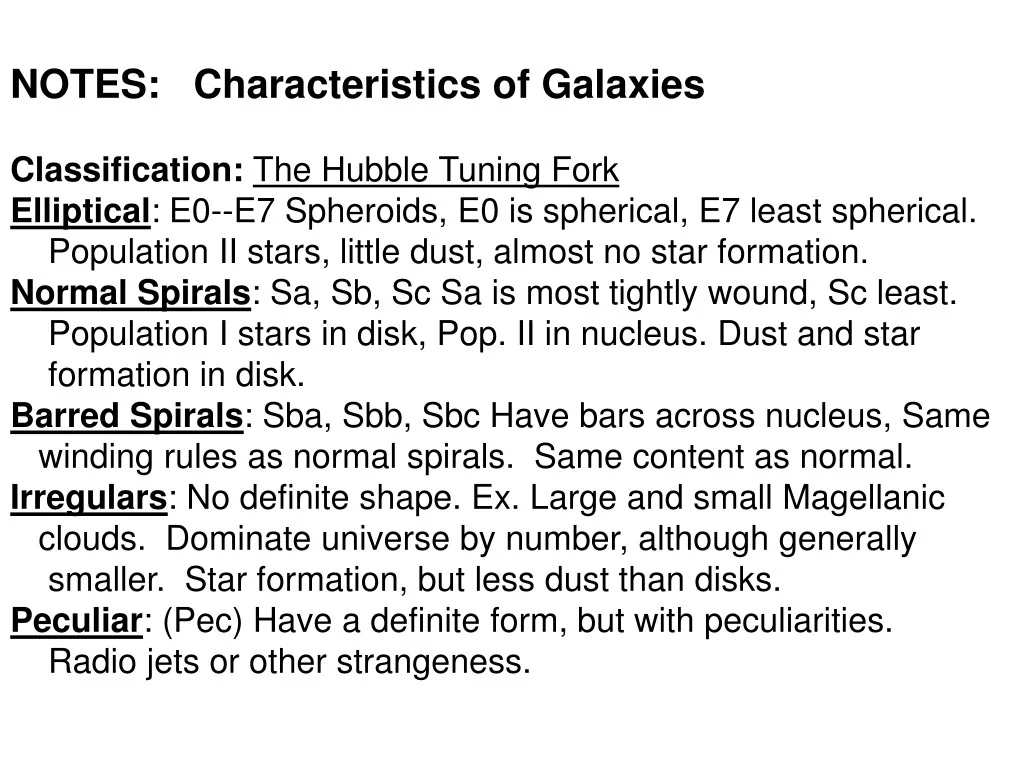
  1. NOTES: Characteristics of Galaxies Classification: The Hubble Tuning Fork Elliptical: E0--E7 Spheroids, E0 is spherical, E7 least spherical. Population II stars, little dust, almost no star formation. Normal Spirals: Sa, Sb, Sc Sa is most tightly wound, Sc least. Population I stars in disk, Pop. II in nucleus. Dust and star formation in disk. Barred Spirals: Sba, Sbb, Sbc Have bars across nucleus, Same winding rules as normal spirals. Same content as normal. Irregulars: No definite shape. Ex. Large and small Magellanic clouds. Dominate universe by number, although generally smaller. Star formation, but less dust than disks. Peculiar: (Pec) Have a definite form, but with peculiarities. Radio jets or other strangeness.

  2. The Hubble Tuning Fork—Classification of Galaxies

  3. Regular and dwarf ellipticals have no dust and are made up of old Pop. II stars

  4. No dust—no aliens!

  5. Supergiant Ellipticals as in Coma rich cluster (rich in dust), formed from galactic mergers?

  6. S0 Galaxy in Sextans (the sextant) no spirals.

  7. M64—the ‘black eye’ galaxy Sa classification

  8. Irregular galaxies (Irr): about ½ of galaxies are Irr. Near the Milky Way

  9. Peculiar Galaxies (Pec) have a shape, but a ding. NGC4631 Pec class spiral galaxy with a ding.

  10. Luminosity class—similar to stars

  11. Fritz Zwicky discovered dark matter in galactic clusters in 1930s.

  12. Galactic mass for large spirals can be Determined from galactic rotation curves.

  13. Which implies the existence of dark matter (not seen). About half is ordinary (baryonic), but other half is exotic. WIMPS, etc.?

  14. We can also find mass from movement in a binary galaxy system or cluster.

  15. Distance: Standard candles--Cepheids, Supernova type Ia, standard galaxies like brightest spiral or Supergiant ellipticals in Cluster cores. If all else fails, Hubble's Law.

  16. Hubble's Law: v = Ho d. Velocity from redshift is proportional to distance. Hubble’s constant = Ho = 70 km/s/Mpc (Friedmann in early ‘1990’s).

  17. Observations of redshift first done by Milton Humason, a janitor at Mt. Wilson Observatory (working for Edwin Hubble.

  18. Diameter: from distance and angular diameter. Diameter = distance times angle (in radians)

  19. How do we get luminosity?

  20. Luminosity: from distance and flux (or mass and Mass-Luminosity relation for main sequence stars).

  21. NOTES: Where are you? You are here--> Earth, Solar System, Milky Way Galaxy... The Local Group: a galaxy 'poor' cluster of 27 galaxies: three large spirals, 12 dwarf ellipticals, 4 ellipticals, and 8 Irr. Dust in the plane of the Milky Way may obscure more. The Local (Virgo) Supercluster: Pancake-shaped. Composed of the Virgo Cluster (a 'rich' cluster) and about 100 other clusters including Local Grp. We are falling toward Virgo Cluster, which has three supergiant ellipticals (M87 contains accretion disk indicating BH or WH in center--a quadrillion solar masses!) The Pisces-Cetus Complex: may include 400 rich (and lots of poor) clusters. Brent Tully. Is the Universe homogeneous? God's Bubble Bath: Galaxy superclusters seem to from in bubble structures and filaments with Voids 100-500 million LY across. Some call this the Cellular Universe. The Great Wall and TheStick Man--supercluster structures. The Great Attractor--hidden by Milky Way Dust in Centaurus. 1017 Mo! May be dense giant supercluster with lots of dark matter. Tens of thousands of galaxies are falling into it, ignoring the Hubble Flow.

  22. What is your cosmic address? Earth, Solar System, Milky Way, then…

  23. The local group—our galaxy cluster--a 'poor' cluster of 27 galaxies: three large spirals, 12 dwarf ellipticals, 4 ellipticals, and 8 Irr. Dust in the plane of the Milky Way may obscure more.

  24. Then the Local (or Virgo) Supercluster

  25. The Local (Virgo) Supercluster: Pancake-shaped. Composed of the Virgo Cluster (a 'rich' cluster) and about 100 other clusters including Local Grp. We are falling toward Virgo Cluster, which has three supergiant ellipticals.

  26. M87 in Virgo contains accretion disk indicating BH or WH in center--a quadrillion solar masses! BH is 2 billion solar masses. Accretion disk is shown on the right. In core:

  27. An X-ray image of the rich galaxy cluster Abell 2142, taken with the Chandra Observatory. This cluster is clearly elongated, and is believed to be the result of a recent merger between two clusters which have fallen together along the long axis.

  28. A larger view!

  29. Galaxy superclusters seem to form in bubble structures and filaments with Voids 100-500 million LY across. Some call this the Cellular Universe.

  30. God's Bubble Bath: thequantum foam the universe may have expanded from minute distortions in space-time.

  31. The Great Attractor —a big lump in the Universe?

  32. Great Attractor: hidden by Milky Way Dust in Centaurus. 1017 Msun! May be dense giant supercluster with lots of dark matter. Tens of thousands of galaxies are falling into it, ignoring the Hubble Flow. Alan Dressler, Sandy Faber, and The Seven Samurai from Harvard discovered it.

  33. At largest scale? Homogeneous? Yes. Confirmed by observations.