Comprehensive Guide to Exam 1: Principles of Energy Economics and Resource Planning
This resource outlines the coverage for Exam 1, focusing on energy economics, expenditure evaluations, cost assessments, and resource planning models. Key topics include financing concepts, cost of capital, energy generation costs, and regulatory frameworks. The examination will assess your understanding of environmental legislation, reliability evaluation, and problem-solving related to capacity outage tables. Students are encouraged to prepare and bring specific problems to the exam, utilizing their notes and study resources while adhering to collaboration guidelines.

Comprehensive Guide to Exam 1: Principles of Energy Economics and Resource Planning
E N D
Presentation Transcript
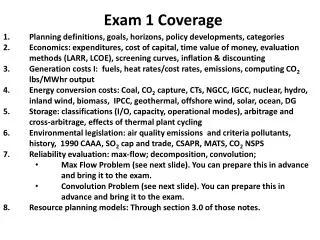
Exam 1 Coverage • Planning definitions, goals, horizons, policy developments, categories • Economics: expenditures, cost of capital, time value of money, evaluation methods (LARR, LCOE), screening curves, inflation & discounting • Generation costs I: fuels, heat rates/cost rates, emissions, computing CO2lbs/MWhr output • Energy conversion costs: Coal, CO2 capture, CTs, NGCC, IGCC, nuclear, hydro, inland wind, biomass, IPCC, geothermal, offshore wind, solar, ocean, DG • Storage: classifications (I/O, capacity, operational modes), arbitrage and cross-arbitrage, effects of thermal plant cycling • Environmental legislation: air quality emissions and criteria pollutants, history, 1990 CAAA, SO2 cap and trade, CSAPR, MATS, CO2 NSPS • Reliability evaluation: max-flow; decomposition, convolution; • Max Flow Problem (see next slide). You can prepare this in advance and bring it to the exam. • Convolution Problem (see next slide). You can prepare this in advance and bring it to the exam. • Resource planning models: Through section 3.0 of those notes.
Exam 1 Coverage You may work these two problems entirely at home and bring them to the exam. You should NOT collaborate with anyone in working these problems. But you can use any resource you like, e.g., notes or books. Beginning from the last step in the class notes on “Reliability” (pg. 74), apply decomposition to identify the A-sets, L-sets, and U-sets for U1, and compute probabilities for each. In section U19.2.2 of the notes on generation adequacy evaluation (pg. 9), we illustrated how to obtain the capacity outage table for a system having two 3 MW units and one 5 MW unit. In this problem, you are to compute the capacity table for this same system. A hint is on the next slide.
Hint for Exam Problem 2 PMF for capacity outage. PMF for capacity.
What to study • Do problems 1 & 2 • HW solutions (to be posted by Friday) • Notes Nature of exam • Some calculations • Some short answer • Some true-false