Phantom Crossing DGP Gravity
This study explores high-precision (p,t) reactions for determining reaction rates crucial to the stellar rapid proton capture process (rp-process). Utilizing the GRAND RAIDEN spectrometer, we focus on measuring resonance energies for unstable proton-rich nuclei such as 32S, 28Si, and 24Mg at Ep=100 MeV. Our findings indicate that existing statistical level density models overestimate the stellar reaction rates, emphasizing the need for improved calculations to understand nuclear processes in cosmic phenomena like novae and X-ray bursters.

Phantom Crossing DGP Gravity
E N D
Presentation Transcript
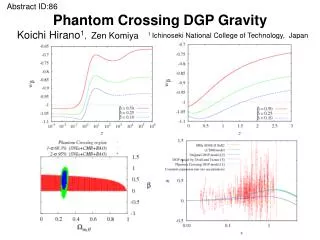
Abstract ID:86 Koichi Hirano1, Zen Komiya 1 Ichinoseki National College of Technology, Japan Phantom Crossing DGP Gravity
High-precision (p,t) Reactions for Reaction Rates in the Stellar rp-process Y. Fujita for the JINA Collaboration Abstract # 91 (p,t) Reactions on N=Z Target Nuclei at Ep=100 MeV 24Mg(p,t)22Mg, 28Si(p,t)26Si, 32S(p,t)30S, 36Ar(p,t)34Ar, 40Ca(p,t)38Ca • Physics Motivation and Experimental Method • Nuclear structure of unstable proton-rich nuclei • Measure precise resonance energies above the • p- and α- thresholds using the high-resolution • GRAND RAIDEN spectrometer (10 – 50 keV) • Calculate improved stellar reaction rates, • determine paths of astrophysics rp process in hot • hydrogen burning in e.g. novae and X-ray bursters Result: Statistical level density model (Hauser-Feshbach) overestimates stellar reaction rates 32S(p,t )30Si, Ep = 100 MeV α threshold p threshold
Study of 12C(g,2a)4He with NewSUBARU laser Compton scattered g-ray beam ID-96 Tatsushi Shima1 Y. Nagai2, S. Miyamoto3, S. Amano3, K. Horikawa3, T. Mochizuki3, H. Utsunomiya4, H. Akimune4 1RCNP, Osaka University, 2Nuclear Science and Engineering Directorate, JAEA, 3LASTI, The University of Hyogo, 4Department of Physics, Konan University 1. Motivation; experimental information for 2. Experimental method Laser Compton scattered g + Time-projection chamber (quasi-monochromatic) (He+CD4; active target) • 12C(g,2a)4He in photodisintegration of SN core • triple-alpha reaction (but 0+2 Hoyle state is not accessible with real photons)
ID-96 3. Result 12C 1- excited states