Download
1 / 13
130 likes | 244 Vues
This article discusses the integration of farm type models with the Farm Accounting Data Network (FADN) to improve our understanding of farm specialization's environmental and policy impacts. It outlines a four-step procedure for integrating FADN data into the CAPRI database, covering selection, aggregation, and modeling. The findings highlight how different farm specializations can influence environmental outcomes by analyzing linkages between activities, such as fodder crops and livestock. The article also addresses unresolved issues and the need for continued access to FADN data.

E N D
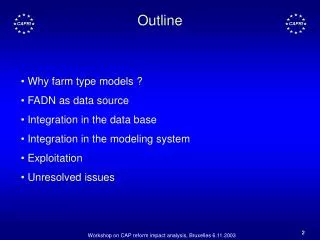
Outline • Why farm type models ? • FADN as data source • Integration in the data base • Integration in the modeling system • Exploitation • Unresolved issues
Why farm type models • Farm specialization matters: • regarding environmental impacts(stocking densities etc.) • regarding policy impacts(farm specific ceilings) • regarding model behavior<=> linkages between activities, especially fodder crops and animals
FADN as data source • Farm Accounting Data Network (FADN): • single farm records covering revenues and costs, production program and certain yields, premiums • but no input allocation • not always clear link to administrative NUTS regions(instead own “FADN” regions) • differences in activity/product breakdowncompared to CAPRI • restricted access due to confidentiality issues
Integration in the data base • Four Step Procedure: • (1) Selection from FADN records • (2) Perfect aggregation of single farms to NUTS II • (3) Aggregation from single farm to farm types • (4) Integration in CAPRI data base
Integration of FADN, Step 1 • select/aggregate/distribute FADN itemsaccording to CAPRI product list Mapping toCAPRI product list FADNrecords FADNCAPRIrecords • Per farm in sample: • Activity levels • Production • Aggregation weights • Farm classification
Integration of FADN, Step 2 • ensure perfect aggregation from individual FADN recordsto NUTS II data in CAPRI data base Consistency(Levels, Output) FADNCAPRIrecords CAPRI database
Integration of FADN, Step 2 • Ensure perfect aggregation by simultaneous determination of optimal correction factors of single farm records for : • activity levels (ha, herd sizes) • yields • aggregation weights • aggregation weights are distributed over regions(a single farm in one region may be “typical” for farmsin other regions as well) => more observations for specific types => no problems with confidentiality limit • Technically: entropy penalty function
Integration of FADN, Step 3 • select the five most frequent types per region • aggregate remaining farms into “residual type” Consistency(Levels, Output)Assignmentto NUTS FADNrecords 6 Typesper region CAPRIdatabase
Integration of FADN, Step 3 • How are types selected ? • Three-digit classification of economic specialization(e.g. 202 Specialist flowers and ornamentals) • Sum up aggregation weights per type and region=> represent number of farms • Select five most frequent ones=> selection by number of agents, not necessarily by economic/environmental impact • all remaining farms aggregated into “residual group”
Integration FADN in the data base CoCo REGIO Consistency(Levels, Output)Assignmentto NUTS 6 Typesper region FADNrecords CAPREG CAPRIdatabase
Integration in the modeling system • Each farm type is treated like a “NUTS III” region • No change in the structure of the supply models • Consequently, now about 1050 regional aggregate modelson the supply side • aggregation to NUTS II/Member State/EUfor premium and market modules
Exploitation CAPRIRegionalisedData Base Mappingtool EXCELetc. CAPRIModellingSystemFarm types Aggregation NUTS II Aggregation MS,EU HTMLtables CAPRIResultData Base DAOUT
Unresolved Issues • Continuous access to FADN data • Farm specific constraints ? • Farm specific policy ceilingse.g. stocking density restrictions • tremendous increase in memory allocationand solution time of complete modelling system