Neutron Damage in Germanium Detectors: Insights from Geant4 Simulation and Experiments
This study focuses on the effects of neutron damage in germanium (Ge) detectors, highlighting the significance of cooling to maintain energy resolution in the detection of gamma rays due to increased thermal excitation and reduced electron mobility. Using data from J-PARC experiments and Geant4 simulations, we estimate neutron flux and damage levels, identifying thresholds for visible and critical damage. The results underscore the importance of maintaining low temperatures during neutron flux exposure to prevent irreversible damage, affecting energy resolution in Ge detectors.

Neutron Damage in Germanium Detectors: Insights from Geant4 Simulation and Experiments
E N D
Presentation Transcript
Neutron damage study Hlab meeting 11/21 K.Shirotori
Introduction Conduction band • Typical energy spacing of hypernuclei is a few 10 keV. ⇒ Only Ge detector can measure these spacing : Energy resolution ~ 2keV • Energy of γ rays are transformed to a lot of electron-hole pairs by EM interaction. ⇔It must be cooled because of the thermal excitation. • Neutron damage in Ge crystal traps the electron and decrease the number. ⇒Energy resolution gets worse. Small energy gap 3eV ⇒Electron easily move to conduction band and e-hole pair is produced. e- Valence band γ × × n p e- e+ (hole) × × Bias V 1 pair/3eV w/o loss
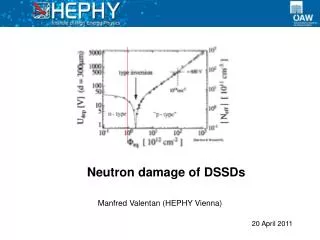
Effects of neutron damage Before After
Purpose • FIFC report for DAY-1 experiment at J-PARC • To estimate the number (flux n/cm2) of neutron hitting Ge detectors by Geant4 simulation and experimental data (E566) • To check the degree of damage • Visible damage: ~109 /cm2 • Critical damage: ~1010 /cm2
GEANT setup • Physics List • Electro-Magnetic • γ→Compton, Photo Electric Effect, e+e- production • e→Multiple Scattering, Ionization, Brems, Annihilation(e+) • μ→Multiple Scattering, Brems, Pair Production, Ionization • その他→Ionization, Multiple Scattering • Decay • Hadron • Low energy elastic • Low & high energy inelastic scattering (<20 GeV)
Event of Simulation Downstream degrader Hyperball Pb collimeter Adjustable degrader upstream degrader K- B1 FV LC B2 B3
Neutron production position E509 Deg, B3, 10B • Geをヒットしたneutronの生成された場所を示す。 • E509ではメインはhyperballが取り囲んでいるdegrader, B3, 10Bターゲットだが、ビームライン上のカウンターやdegraderからも来ている。 • For E509, 660MeV was generated • For E556, 1050MeV + was generated LC Deg Ge target 20cm CH2 E566
Neutron Number • 100000 (E509) and (E566) were generated • E509 1311 neutrons for one Ge • 0.01311 neutron per beam • E566 672 neutrons for one Ge • 0.00672 neutron per beam ⇒8.74×10⁹ /Ge @ 1.3×10¹² π+ beam
Estimation from p cross section • Total cross section p at p=1GeV/c • =~25mb, (elastic ~10mb) • 20cm CH2 d=0.93(g/cm3) • N(H) = 0.93*20*2/14*6*1023=15.9*1023個/cm2 • N(C) = 0.93*20/14*6*1023=7.97*1023個/cm2 • For p • Nscat/Nin=0.04 • For C (assume (C) = (p)*A2/3) • Nscat/Nin=0.10 • Target is so thick, there are many reaction events.
Number of neutron from E566 data • Run140~543 @ Beam trigger • All sum of single Ge ADC spectrum • W/o Timing gate • Ge live time 0.55 • DAQ live time 0.84
ADC spectrum w/o TDC timing gate (Single ADC sum) Number of peak (2.31±0.22)×103 →193±18 /Ge (12 single Ge worked)
300×(693 keVピーク数) (中性子数/cm2 )= (Ge検出器の体積 [cm3]) Estimation of neutron flux • 公式を使用 (Geの体積) = π×3.52×7=269.4 cm3 (Geの表面積) = π×3.52 = 38.48 cm2 (単純に正面から中性子が入ったと仮定) (中性子数) = (8.27±0.77)×103個/Ge
Neutron 数 : Run140~534 • (中性子数/Ge) = (8.27±0.77)×103 • π+ビーム数 : 1.24×10¹² • Prescale factor 5.0×10⁵ • (中性子数/Ge) = (4.14±0.39)×109 • (中性子数/π+/Ge) = (3.34±0.31)×10-3 ⇒(w/ Dead time) = (7.59±0.70)×10-3 Ge 0.55, DAQ 0.84 総π+ビーム 1.3×10¹² ⇒(9.87±0.91)×109 /Ge
Triggerによる比較 • 単に(π+, K+)をビームと同数だとみなして計算 • Beam triggerと(π+, K+) trigger Beam : (9.87±0.91)×109 /Ge (中性子/π+) = (7.59±0.70)×10-3 (π+, K+) : (5.41±0.09)×1010/Ge (中性子/(π+, K+)) = (4.16±0.09)×10-2
Summary • Beam triggerで見積もった中性子数はSimulationと合う ⇒8.71×10⁹ /Ge(Sim:0.00672⇔Exp:0.00759 /π+) Beam • (9.87±0.91)×109 /Ge • Flux (2.55±0.24)×108 /cm2/Ge (π+, K+)のみ • (5.41±0.09)×1010 /Ge • Flux (1.41±0.02)×109 /cm2/Ge • 文献によると • 測定可能な損傷 : ~109 /cm2 • 深刻な損傷 : ~1010 /cm2 ⇒損傷の現れ具合とほぼ一致する
During the irradiation (experiments) line shapes/neutron tail depends sensitively on Ge crystal temperature and also on counting rate. Thus Ge detectors must be kept cold below 85K during the course of an experiment for ~108 n/cm2neutron flux. Once Ge crystal temperature raises, the effect is irreversible unless thermal cycled and annealed. Annealed detector’s resolution/residual tail is NOT so sensitive to Ge crystal temperature. Worsening of Ge resolution with increasing Ge crystal temperature is due to the increased thermal leakage current. Response to FIFC