Download
1 / 9
90 likes | 222 Vues
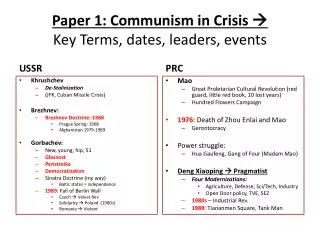
The Brezhnev Era (1964-1982) faced significant crises in the Soviet Union, characterized by economic stagnation, declining living standards, and food shortages due to crop failures. Despite attempts at reform, such as incentivizing farmers and introducing market forces, the rigid command economy failed to meet citizens' needs. Political stagnation persisted, with an aging leadership disconnected from youthful aspirations. Additionally, foreign challenges like nationalist movements and the costly arms race intensified pressures on the regime, culminating in the eventual rise of Mikhail Gorbachev in 1985.

E N D
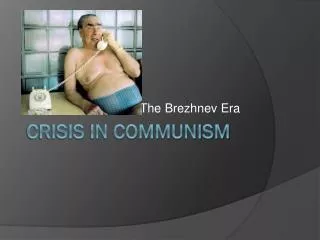
The Brezhnev Era Crisis in communism
Domestic Problems • Economic stagnation – standard of living began to decline beginning in 1970 • Crop failures in 1972 lead to food shortages • From 1964-1982 over 25% of the Soviet GNP was spent on military growth to compete with the US • Socialist centralized economic planning (command economy) was NOT meeting the needs of ordinary citizens (guns vs. butter)
Brezhnev’s Reforms • Incentives to farmers working on state-owned plots – keep or sell surplus! • Promoted the use of market forces to determine production • Reforms were blocked by Soviet hard-liners who feared a shift to capitalism
Things Get Worse • Consumer goods are only readily available on the black market (except for those with the right connections) • Morale and productivity decline – high rates of absenteeism and alcoholism • 1975 – another bad grain harvest • USSR has to import food - from the US!
Political Stagnation • Same organization and hierarchy as the days of Stalin • Leadership was ageing and out of touch with new generation of Soviet youth (gerontocracy – form of rule in which the leadership is significantly older than the adult population. Politburo average age – 73!) • Party elites (nomenklatura) and military leaders were often corrupt and benefited from their position at ordinary citizens’ expense
Foreign Problems • Nationalist movements behind the Iron Curtain • 1968 – The Prague Spring: socialism with a human face! • The Brezhnev Doctrine – “..every Communist party is responsible not only to its own people, but also to all the socialist countries and the entire Communist movement….” • In Poland the Solidarity workers’ union begins staging strikes and protest marches
The Cold War Arms Race • The missile race, the space race, the technology race, conventional arms race, etc. etc. – very expensive • Détente – Soviets motivated by economic as well as geo-political pressures
Afghanistan • Invoking the Brezhnev Doctrine the Soviets invaded in 1979 to prop up the leftist regime on their southern border • By 1982 it was a lost cause – and increasingly expensive in both economic and political terms
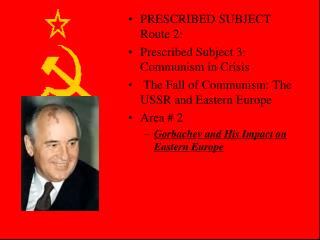
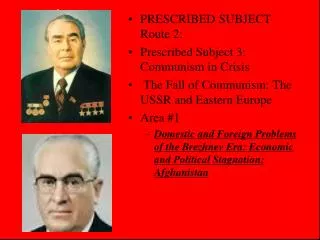
The End of an Era • 1982 – Brezhnev dies and Andropov (age 68) takes over • 1984 – Andropov dies and Chernenko takes over • Early 1985 – Chernenko dies • March 1985 – Mikhail Gorbachev, a spritely 54, becomes General Secretary