An Overview of Nuclear Power: Fission, Safety, and Its Contributions to Energy
Nuclear power harnesses the process of nuclear fission, where a nucleus splits into smaller nuclei, releasing energy. Most uranium found in nature is uranium-238, while uranium-235, necessary for fission, makes up only a small fraction. The development of nuclear power saw significant milestones, including the discovery of neutrons and a series of experiments leading to practical applications. While accidents like Chernobyl raised safety concerns, modern reactors incorporate lessons learned to enhance safety. Today, nuclear plants contribute around 20% of electricity in the U.S., demonstrating their role in energy production.

An Overview of Nuclear Power: Fission, Safety, and Its Contributions to Energy
E N D
Presentation Transcript
Nuclear Power – An Overview Prepared and Presented by Mauricio Campuzano GK-12 Fellow Stevens Institute of Technology
Nuclear Power Profit! Nuclear Fission Nuclear Fission
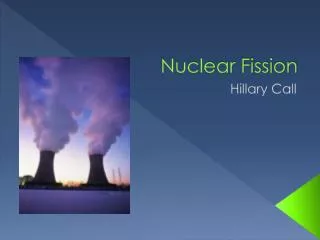
Nuclear Fission • Nuclear Fission is the process by which a nucleus splits into smaller nuclei , while also releasing gamma rays and free neutrons • Most naturally occurring Uranium is 238U, while 235U composes only 0.71%
Where did it come from? • 1932: James Chadwick discovers Neutron • 1934: Enrico Fermi Bombards Uranium with Neutrons1938: Otto Hahn and Fritz Strassmannshow that Barium is produced after Neutron bombardment.
Not so easy… • To sustain continuous fission, a chain-reaction is necessary • Uranium needs to be enriched to contain 2-3% of 235U for the chain reaction to take place
Is it safe? • Depends on who you ask! • In 1986, a reactor at the Chernobyl plant, in the Ukraine, experienced a series of power surges which results in a rupture in the reactor vessel and a plume of radioactive debris and fallout; 28 persons died on site, and another 4,000 deaths appear to be attributable to the accident. • The accident was a symptom of the lack of a “culture of safety” within the USSR
So it isn’t safe…? • Actually, disasters such as the Chernobyl catastrophe have led to changes in design, making modern Nuclear plants much safer. • Within the US, there are over 100 nuclear reactors • These supply about 20% of our electricity
References • http://en.wikipedia.org/wiki • http://science.howstuffworks.com/nuclear-power.htm • http://www.fema.gov/areyouready/nuclear_power_plants.shtm • http://library.thinkquest.org/17940/texts/fission/fission.html • http://www.epa.gov/radtown/uranium-mines.html • http://www.chalkbored.com/lessons/chemistry-12.htm