Group Speech Workshop: Instructions and Guidelines for Persuasive Presentations
Join us for the Group Speech Workshop, where you will collaborate in teams to deliver persuasive speeches. Form your group by April 1st and choose your topic early! Each team consists of 4-5 members, and your speech should be 4-6 minutes long. Ensure you conduct thorough research with at least four credible sources. Utilize a PowerPoint for your visual aid, which must be emailed by 9 a.m. on your presentation day. Learn the art of persuasion, audience analysis, and develop your speeches with clear structure and compelling delivery.

Group Speech Workshop: Instructions and Guidelines for Persuasive Presentations
E N D
Presentation Transcript
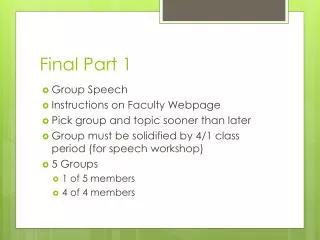
Final Part 1 • Group Speech • Instructions on Faculty Webpage • Pick group and topic sooner than later • Group must be solidified by 4/1 class period (for speech workshop) • 5 Groups • 1 of 5 members • 4 of 4 members
Persuasive Speeches Chapter 16 Recap/Lecture
Your next speech…. • April 8th and 10th • Speech sign ups: Thursday, April 3rd • 4 to 6 minutes • Research required: at least 4 sources (with citations) • Areas of Focus: EVERYTHING • Materials: Keyword outline & note cards • Visual aid: PowerPoint (emailed to powerpoints2goldman@gmail.com by 9 a.m. on the day of your presentation; also bring back up copy) • Will discuss use of PowerPoint next week (change in syllabus)
Informative vs. Persuasive • Knowledge and Understanding vs. Attempting to change or convince • Similarities: clear and concise, organized, strong delivery, ethical, credible, appropriate use of language
Importance/Role of Persuasion • Persuasive speech: ‘attempting to create, reinforce, or change your audience’s beliefs or actions’ (p. 300) • Understanding persuasion—important for speakers and listeners • Speaker as advocate
Ethical Persuasion • Ethical goals and methods • Avoid subtle and blatant dishonesty • Power of language • ‘learn about all sides of issue and competing viewpoints’ (p. 301)
Persuasion as Psychological Process • 2 or more viewpoints; competing or different angle/degree • Degrees of Persuasion • Strongly opposed -------------- Strongly in favor • Audience analysis/centeredness knowledge AND attitude • Mental dialogue (give and take) with audience • Set realistic goals • Will everyone change their beliefs/opinions after hearing one speech?
Target Audiences; Audience Centeredness • Advertising = big example of persuasion and targeting audiences • Check out these ads; what’s the persuasive message & who is the target audience?
Types of Persuasive Speeches • Persuasive speeches on • Questions of Fact • Questions of Value • Questions of Policy
Addressing Questions of Fact • True answer exists; may not have enough information yet • Inconclusive info • Speculations and Predictions • Choose side -- present those facts, persuasively • Popular org. pattern – Topical • Main points = reasons to agree
Addressing Questions of Value • Includes facts; Demands value judgments • Right or wrong? Good or bad? Moral or immoral? Fair or unfair? • Pick a side; justify your claim • Standards for the value judgment? • Popular org. pattern – Topical • Establish the standards apply the standards
Addressing Questions of Policy • Course of action – should or shouldn’t be taken • Can include questions of fact and/or value; step further by deciding what should be done • Passive agreement vs. Immediate action • Convincing that something should be done vs. Convincing someone to do what should be done (specific call to action) • Must identify need, plan, and practicality
Addressing Questions of Policy • Popular org. patterns • Problem-Solution Order • Need/seriousness of problem plan for solving the problem/practicality • Problem-Cause-Solution Order • Identify the problem analyze cause of problem solution to problem • Comparative Advantages Order • Each main point = why your solution is better than others • Monroe’s Motivated Sequence (MMS) • Attention, need, satisfaction, visualization, action • Will practice next week
Looking ahead… • SW#15 Today – Speech Plan Form & Audience Analysis • SW #16 Due 3/20 – Example of Persuasive Speech • SW #17 Infomercials using PowerPoint and Aristotle's Appeals – In class 3/25 and 3/27 • Personal computers vs. computer lab on 3/25 (waiting on confirmation) • SW #18 Practicing problem solving with group – In class 4/1 and 4/3 • SW#19 Critiques for Speech 3 • SW #20 Impromptus on 4/22
Speech Workshop #16 • Find an example of a short GOOD or BAD persuasive speech • Be prepared to pull up link and discuss • Bring in a typed 1 page document with the following • Link to speech • Explanation of why it was good or bad • You must comment on speakers persuasive technique, organization, AND delivery • Should be at least a paragraph!