SlideServe
Menu
Préférences
© SlideServe · v2026

Understanding Decision Theory: Evaluating Outcomes in Betting and Investing Scenarios

morwen avatar
4 diapositives · 185 Views · Aug 01, 2014

This article explores decision theory by analyzing two scenarios: betting on a green or red chip and investing in stocks versus bonds. Each scenario aims to maximize returns while considering probabilities and expected values. For the betting scenario, there’s an 80% chance of winning when betting on green. In the investment scenario, an 80% chance exists for economic improvement favoring stocks over bonds. We evaluate the outcomes of good and bad decisions and their consequences, highlighting the importance of probability in decision-making.
Understanding Decision Theory: Evaluating Outcomes in Betting and Investing Scenarios - slide 1
01 / 4Understanding Decision Theory: Evaluating Outcomes in Betting and Investing Scenarios
1 / 17

Télécharger la présentation

Understanding Decision Theory: Evaluating Outcomes in Betting and Investing Scenarios
Une image / un lien ci-dessous est fourni (tel quel) pour télécharger la présentation

Politique de téléchargement : le contenu du site vous est fourni TEL QUEL pour votre information et votre usage personnel ; il ne peut être vendu, concédé sous licence ni partagé sur d’autres sites sans l’accord de son auteur.Le contenu vous est fourni TEL QUEL, pour votre information et votre usage personnel uniquement. Téléchargez la présentation en cliquant sur ce lien. Lors du téléchargement, si vous ne parvenez pas à télécharger une présentation, l’éditeur a peut-être supprimé le fichier de son serveur.Pendant le téléchargement, si vous ne parvenez pas à obtenir une présentation, le fichier a peut-être été supprimé par l’éditeur.

F I N

Plus de contenu associé

Transcription de la présentation
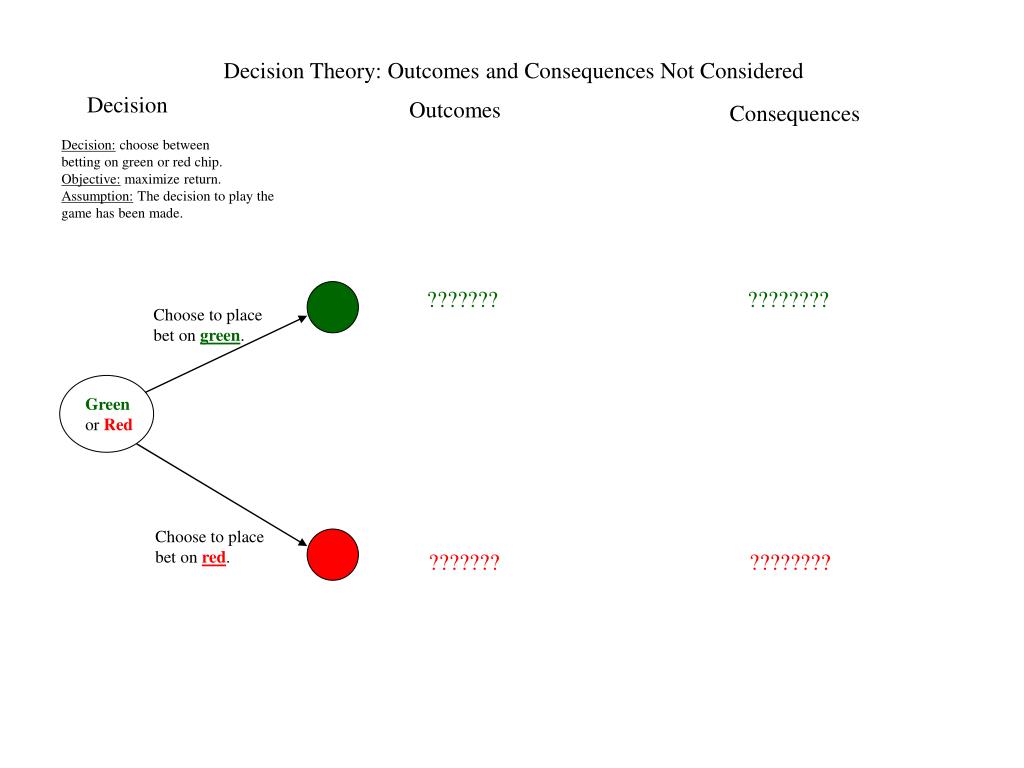
  1. Decision Theory: Outcomes and Consequences Not Considered Decision Outcomes Consequences Decision: choose between betting on green or red chip. Objective: maximize return. Assumption: The decision to play the game has been made. ??????? ???????? Choose to place bet ongreen. Green or Red Choose to place bet on red. ??????? ????????

  2. Decision Theory Example #1 Decision Outcomes Consequences Probability: There is an 80% chance that a green chip will be drawn and a 20% chance that a red chip will be drawn. Decision: choose between betting on green or red chip. Objective: maximize return. Assumption: The decision to play the game has been made. 80% x $1.00 = $.80 expected value Win $1.00 Green is drawn. prob. = 80% Good Decision, Good Outcome Ave. exp. value = Win $.60 Choose to place bet on Green. Redis drawn. prob. = 20% Lose $1.00 20% x ($1.00) = ($.20) expected value Good Decision, Bad Outcome Green or Red Green is drawn. prob. = 80% Lose $1.00 80% x ($1.00) = ($.80) expected value Bad Decision, Bad Outcome Choose to place bet on Red. Ave. exp. value = Lose $.60 Red is drawn. prob. = 20% Win $1.00 20% x $1.00 = $.20expected value Bad Decision, Good Outcome

  3. Decision Theory – Outcomes and Consequences Not Considered Decision Outcomes Consequences Decision: choose between investing in ????????? Objective: maximize return. Assumption: The decision to invest has been made. ????????? ?????????? Choose to invest in ?????? ????? or ????? Choose to invest in ????? ????????? ??????????

  4. Decision Theory Example #2 Decision Outcomes Consequences Probability: There is an 80% chance that the economy will improve significantly and a 20% chance that the economy will deteriorate significantly. Decision: choose between investing in stocks or investing In bonds Objective: maximize return. Assumption: The decision to invest in the Stock market or bond market has been made. 80% x 10% = 8% expected value Gain 10% Economy improves prob. = 80% Good Decision, Good Outcome Ave. exp. value = Gain 6% Choose to invest instocks. Lose 10% 20% x (10%) = (2%) expected value Economy deteriorates prob. = 20% Good Decision, Bad Outcome Stocks or Bonds? Economy improves prob. = 80% Lose 10% 80% x (10%) = (8%) expected value Bad Decision, Bad Outcome Choose to invest in bonds. Ave. exp. value = Lose 6% Economy deteriorates prob. = 20% Gain 10% 20% x 10% = 2%expected value Bad Decision, Good Outcome