Understanding Set Relationships and Sequence in Counting
This educational content focuses on the concepts of grouping, comparative quantities, and sequencing in relation to objects and numbers. It covers the definitions and examples of terms such as "greater than," "less than," "same as," "before," "after," and "next." Through relatable examples like comparing the number of pumpkins and leaves or identifying the order of numbers, it helps learners grasp the fundamental principles of quantity relationships and sequential order, which are essential skills in early mathematical education.

Understanding Set Relationships and Sequence in Counting
E N D
Presentation Transcript
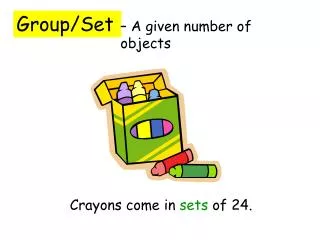
Group/Set – A given number of objects Crayons come in sets of 24.
Greater / More Than a larger amount Are there a greater amount of pumpkins or leaves?
Same As/ Equal • To be identical or the same amount.
Less / Smaller Amount a number or set that has fewer; smaller There are less kittens than puppies.
Before • Before I start school I eat cereal for breakfast. • When counting 2 is before 3.
After/ Following • After I take a bath I dry off with a towel. • When counting 5 is after 4.
Next • First, my dad put the soup on the table. • The next thing I do is let my soup cool. When counting 1, 2, 3, 4 comes next.
In Between The yellow book is in between the red book and blue book. When counting 4 is in between 3 and 5.