Comprehensive Security Strategies for Detention Facilities
Ensuring safety in detention facilities requires a robust security program focused on the well-being of inmates, staff, and the public. Key objectives include maintaining order, preventing escapes, and effective supervision. Essential elements involve advanced preparation, time management, and ongoing communication among staff and residents. A positive facility climate, characterized by clean living conditions, adequate medical care, and fair rule enforcement, enhances safety. Staff training in communication and physical fitness also plays a critical role in responding to potential threats.


Comprehensive Security Strategies for Detention Facilities
E N D
Presentation Transcript
Safety and Security By: Matthew Kuehl
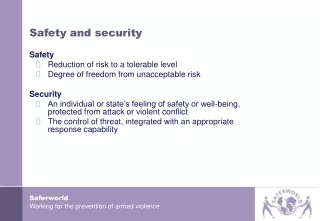
Every detention facility must have a good overall program for ensuring security. The objectives of such a program are the same in every facility, no matter what the size of the detention facility or the mode of supervision of inmates. The basic goals of security include: • To ensure the safety of inmates , staff and the public • To maintain order and control; and • To prevent escapes
Three Considerations • Advance Preparation • Time management • Mental Preparedness • Physical Preparedness
Effective facility security is achieved through implementation of accepted correctional principles and procedures in such areas as: • Searching residents • Using keys and locking systems correctly • Conducting security checks • Searching cells, cellblocks and other areas of the facility • Counting residents • Controlling weapons • Controlling tools and utensils • Using surveillance equipment
However, these procedures are only part of good security. The other part involves good, ongoing supervision of residents and establishment of a positive climate. If these are present, then there will likely be fewer problems with residents and thus fewer problems related to safety and security.
ELEMENTS OF GOOD SUPERVISION • Ongoing observation of residents and resident activities by staff members; • Good, ongoing communication between staff members and residents; • Good, ongoing communication between staff members on all shifts and between officers and the supervisory team; and • Good documentation and report writing.
A GENERALLY POSITIVE FACILITY CLIMATE HAS THE FOLLOWING CHARACTERISTICS • Clean, sanitary living conditions; • Good food, in sufficient quantities; • Adequate, timely medical and health care; • Equal and fair enforcement of rules and regulations; • Adequate opportunity for visits; • Availability of programs; • Knowledge by residents that they can talk to staff members, and that they will be listened to.
Knowledge • Department Policy and Procedure • Your Partner • Strengths • Weaknesses • Resident • Facility • Continuum of Force
Your Partner is Essential for • Safety • Partnering reduces the odds of being attacked • A witness • A sounding board
“The brain is the primary weapon, all else is supplemental” John Steinbeck
The Essential Tools • Presence – uniform, grooming, stance • Knowledge – policies and procedures • Training Retention • Communication Skills – Staff to Resident and Staff to Staff • Verbal • Non-verbal • Para verbal – how you say what you say • Proximal space • Principals Of Subject Control
States of Awareness • White – totally unaware of your surroundings • Yellow – relaxed but alert • Orange – state of general alarm – analyze: avoidance/defensive tactics • Red – the problem has occurred – defensive tactics • Black – blind panic
Mental Pitfalls • “We’ve always had a good relationship” • “He’s okay, I know him” • “I can handle him” • “She’s been here before and was no problem” • “There're only kids”
Three Possible Responses to Threat • Over-Reaction • Under-Reaction • Appropriate Reaction
Remember… • Always expect the unexpected • Stay focused • Take charge of the situation – Don’t let the situation take charge of you!
Why Physical Fitness? • Your own health – Stress reduction • Personal satisfaction • Regular exercise increases your reaction time by 15% and increases your motor skills • Confidence / control • Increased ability to perform job functions