Enzymes Part 2
Enzymes are biological catalysts that speed up chemical reactions without being consumed. They lower the activation energy required for reactions and form enzyme-substrate complexes, akin to a lock and key mechanism. This review explores various factors affecting enzyme activity, including enzyme concentration, substrate concentration, temperature, and pH levels. Increasing enzyme or substrate concentrations can enhance reaction rates, but only to a point. Temperature and pH must remain within specific ranges for enzymes to function effectively, as extremes can lead to denaturation, rendering enzymes inactive.

Enzymes Part 2
E N D
Presentation Transcript
Enzymes Part 2 Factors that affect enzyme activity
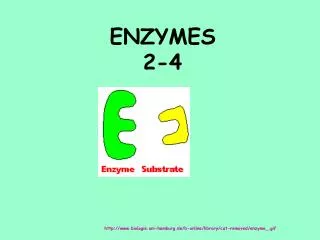
Enzymes Review • Proteins • Biological catalysts • Speed up a chemical reaction without being used up in the reaction. • Lower the activation energy of the reactants. • Enzymes fit with their substrate like a lock and key. • Forms enzyme substrate complex. • When enzyme bonds, it weakens the chemical bonds of the substrate. • The enzyme is unchanged by the reaction and can be used again.
Induced Fit model • Enzyme changes shape slightly when it comes in contact with the substrate.
Factors that affect enzyme activity • Enzyme Concentration • Substrate concentration • Temperature • pH
Enzyme Concentration • If you increase the enzyme concentration, the rate of reaction will increase to a certain point and then level off. • By increasing the amount of enzymes, you increase the chances of them bumping into a substrate. • The rate levels off because eventually there is not enough substrate for the enzymes to find.
Substrate Concentration • If you increase the substrate concentration, the rate of reaction will increase to a certain point and then level off. • At first, enzymes will run into lots of substrate molecules because they are plentiful.
Temperature • An increase in temperature will increase the rate of reaction until it gets too hot. • Once too hot, the rate of reaction will denature (break down) • Enzyme will no longer fit with the substrate. • Reaction will not occur. • Increasing temp makes molecules move faster. (more likely to bump) • Lower temp makes molecules move slower. (less likely to bump)
ph • 0-6 acid • 8-14 basic • 7 neutral • Each enzyme has an optimal pH. • If pH is not optimal, enzyme will denature (break down) • The enzyme will no longer fit with substrate. • Reaction will not occur.