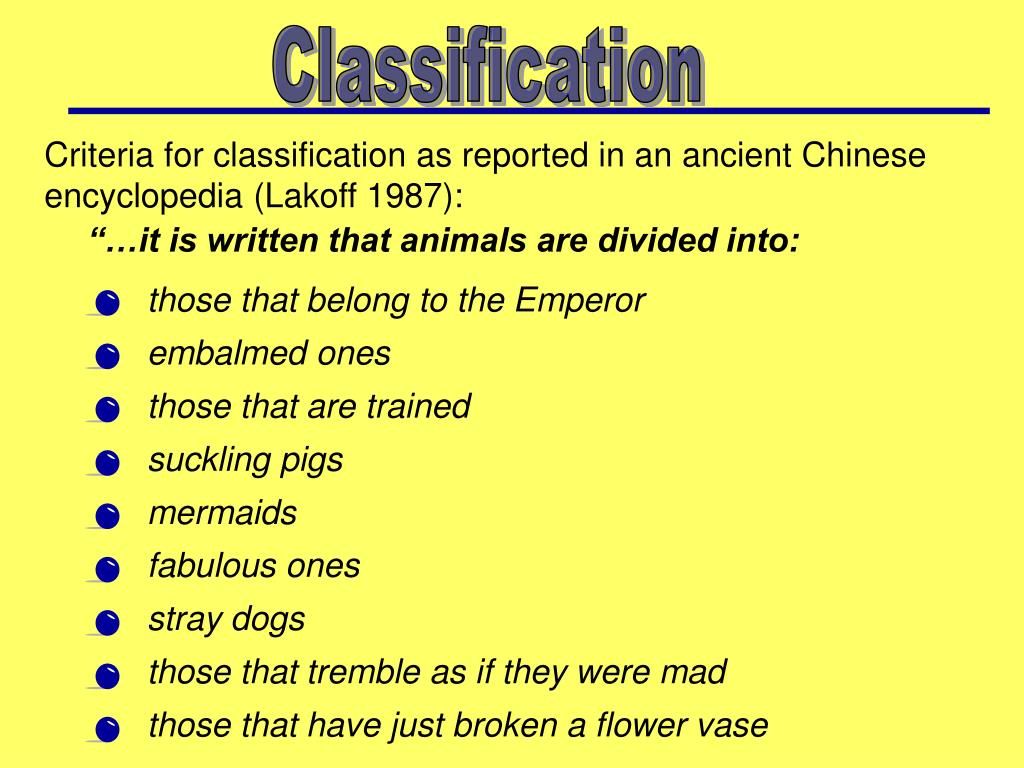
Classification. Criteria for classification as reported in an ancient Chinese encyclopedia (Lakoff 1987):. “…it is written that animals are divided into:. those that belong to the Emperor. embalmed ones. those that are trained. suckling pigs. mermaids. fabulous ones. stray dogs.
01 / 165Criteria for classification as reported in an ancient Chinese encyclopedia (Lakoff 1987):
1 / 17
Télécharger la présentation
Criteria for classification as reported in an ancient Chinese encyclopedia (Lakoff 1987):
Une image / un lien ci-dessous est fourni (tel quel) pour télécharger la présentation
Politique de téléchargement : le contenu du site vous est fourni TEL QUEL pour votre information et votre usage personnel ; il ne peut être vendu, concédé sous licence ni partagé sur d’autres sites sans l’accord de son auteur.Le contenu vous est fourni TEL QUEL, pour votre information et votre usage personnel uniquement.Téléchargez la présentation en cliquant sur ce lien.Lors du téléchargement, si vous ne parvenez pas à télécharger une présentation, l’éditeur a peut-être supprimé le fichier de son serveur.Pendant le téléchargement, si vous ne parvenez pas à obtenir une présentation, le fichier a peut-être été supprimé par l’éditeur.
F I N
Plus de contenu associé
Transcription de la présentation
Classification Criteria for classification as reported in an ancient Chinese encyclopedia (Lakoff 1987): “…it is written that animals are divided into: those that belong to the Emperor embalmed ones those that are trained suckling pigs mermaids fabulous ones stray dogs those that tremble as if they were mad those that have just broken a flower vase
Systematics- studies diversity of life It is the study and classification of organisms with the goal of reconstructing their evolutionary history Taxonomy- the field of science that classifies life into groups
Five kingdom system: Monera Protista Plantae Fungi Animalia Six kingdom system: Eu- bacteria Archae-bacteria Protista Plantae Fungi Animalia Three domain system: Eu- bacteria Archae-bacteria E U K A R Y A Eight kingdom system: Eu- bacteria Archae-bacteria Plantae Fungi Animalia Archezoa Protista Chromista Biological Kingdoms
Classification: Six kingdom system : Eubacteria Archaebacteria E. coli Cyanobacteria Protista Paramecium Diatom Slime mold Plantae Fungi Animalia
Six kingdom system: Monera Eu- bacteria Archae-bacteria Protista Plantae Fungi Animalia
Names • Common names • Confusing • Ambiguous • Scientific names • Agreed upon system • Portuguese Man-of-War • Bluebottle • Physalia physalis
Names • Language • Latin or Latinized • Giving names • A highly technical process • Name is author’s choice
Commemorate People Gardenia jasminoides (Dr. Alexander Garden) Camelliajaponica (Joseph Kamel) Strelitzia reginae (Queen Charlotte of Mecklenburg-Strelitz) Siegesbeckia orientalis (Dr. Siegesbeck)
Descriptive Cardinalis cardinalis(red) Railus aquaticus(watery) Passer domesticus(house)
Pronunciation Divide into syllables Choose where to place emphasis
Example of Coral Classification The Mushroom Coral Fungia scutaria Kingdom Animalia Phylum Cnidaria Class Anthozoa Order Scleractinia Family Fungiidae Genus Fungia Species scutaria
Biological Species Organisms that are genetically similar, and have ability to interbreed and produce viable, fertile offspring
Kingdom Protista Eukaryotic Generally single-celled; if multicellular, cells not organized into tissues Heterotrophic & autotrophic forms ~ 45,000 species
Fungus-like Protists Mildew Water molds Blights Downey mildew 475 species Slime molds
Kingdom Plantae Eukaryotic Multicellular organisms True tissues. Photoautotrophic nutrition. Most adapted for a terrestrial existence and possessing vascular tissues.
Kingdom Plantae Cells with chloroplasts and cellulose cell walls. Includes mosses, ferns, pine trees, cycads, ginkgos, and flowering plants.
Kingdom Plantae Sea grasses Halophilia hawaiiana- only form of seagrass in Hawaii