Statistics Sweden case study update
150 likes | 199 Vues
Discover how Statistics Sweden streamlined processes with integrated metadata systems, driving information flow and data consistency. Learn about architecture vision, current systems, costs, benefits, and future goals.


Statistics Sweden case study update
E N D
Presentation Transcript
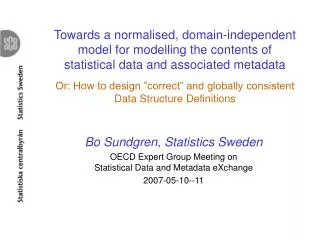
Statistics Sweden case study update Klas Blomqvist klas.blomqvist@scb.se
Strategy • Process oriented production, overall strategy, focus on customers, efficiency and standardisation • No separate strategy for metadata - included in the overall strategy • The goal is to have common metadata for the whole organisation • Metadata - driving and delivering information between different process steps
Current situation • Implemented: • SCBDOK, Description of the statistics including the Quality Declaration, MetaPlus, The Classification database, The Process support system, The statistical databases, The Product database. • Ongoing projects: • Triton, The information model project, ENAR, MetaPlus development, connecting micro and macro metadata, The Process support system, The Product database
Metadata system(s) • Description of the statistics • SCBDOK • MetaPlus • The classification database • Macro meta • The product database • The process suport system • FMOD
Costs and Benefits • Several metadata systems that are not formally connected. • Drawbacks: the same information has to be loaded manually into several systems • Positive: flexible, fitting specific demands • Vision – make an integrated system • Not one giant system, subsystems that are linked • Stepwise implementation approach
Metadata relevant to other business processes • Arken, the Archiving system • PuL, Data acts requests
IT Architecture • The IT architecture at Statistics Sweden aims at maintaining a comprehensive Swedish statistics system • Focus: • Consistency, structured and well documented data warehouse(s) • Use registers when possible • Minimize duplicate data and data transports • Support process oriented production • Support efficient data collection • Support flexible dissemination
Base registers • The foundation • 3 base registers, individuals, business/organizations and real estate. The base registers are statistical register that are: • Managing basic object types • Defines object types and connections • Center of “sphere of interest” • Autonomous • Has links to other base registers • Containing stock variables (mainly) • Containing time-stamped data
Overview of roles and responsibilities • Decentralized responsibility for registering metadata • The statistical databases for which registering metadata is centralized • Guidelines and follow-up
Organisation and training • Organisation • The Process department • The Research and development department • The subject matter departments • The communication department • Training and knowledge management • The KMI-area, Process department • The documentation network • The classification group
Questions? • The end…