Concentration and Solubility
90 likes | 269 Vues
This guide explores the fundamental concepts of concentration and solubility in solutions. A dilute solution contains a small amount of solute, whereas a concentrated solution has a large amount. Concentration can be adjusted by adding solute or solvent. Solubility measures the maximum amount of solute that can dissolve in a solvent at a given temperature. A saturated solution holds the most solute possible, while an unsaturated solution can dissolve more. Factors affecting solubility include pressure, temperature, and the nature of the solute and solvent.


Concentration and Solubility
E N D
Presentation Transcript
Concentration and Solubility BY: Ray Diaz, Jacob White, Daniel Hennessey, and Connary Kennedy
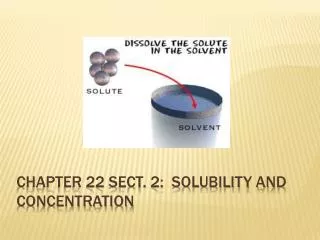
Concentration • A Dilute Solution Is a mixture that has only a little solute dissolved in a certain amount of solute • A concentrated Solution has a lot of solute dissolved in the solvent.
Changing Concentration • You can change the concentration of a solution by adding more solute. • You can also change it by adding or removing solvent.
Measuring Concentration • To measure concentration, you compare the amount of solute to the amount of solvent, or the total amount of solvent. • The method used to describe the Concentration depends on the type of solution.
Solubility • Solubility is a measure of how much solute can dissolve in a solvent at a given temperature. • A Saturated solution Is a mixture that contains as much dissolved solute a possible. • An unsaturated solution can dissolve more solute.
Working with Solubility and Using Solubility • The solubility of a solution tell you how much solute you can dissolve before a solution Is saturated. • Solubility can be used to help identify a substance because it is a characteristic property of matter.
Factors Affecting Solubility: Pressure • Factors that affect solubility of a substance include pressure, the type off solvent, and temperature. • Pressure affects the solubility of gases. • The higher the pressure of the gas over the solvent, the more gas can dissolve
Solvents • Sometimes, you can’t make a solution because the solute and solvent are not compatible. • Polar compounds and nonpolar compounds don’t mix well. • For liquid solutions, the solvent affects how well the solute dissolves. • Ionic and Polar compounds dissolve in polar compounds.
Temperature • For most solids, solubility increases as temperature increases. • Gases become less soluble as temperature goes up. • When heated, solutions can dissolve more solute than at a cooler temperature. • A supersaturated solution has more dissolved solute than is predicted by it solubility at a given temperature.