Population Growth Curves
190 likes | 371 Vues
This overview of ecological concepts covers essential aspects such as population growth curves, including exponential and logistic growth, and the dynamics of predator-prey relationships. It highlights the role of biotic and abiotic factors, energy flow through ecosystems, and the significance of food chains and webs. Additionally, it addresses the importance of biodiversity, genetic variation, and the threats to ecosystems, such as habitat loss and introduced species. By fostering a deeper understanding of these relationships, we can better appreciate the intricacies of our planet's ecosystems.


Population Growth Curves
E N D
Presentation Transcript
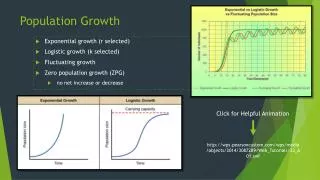
Population Growth Curves Exponential vs. Logistic Growth Predator-Prey Population Cycles
What do Ecologists Study? • Ecosystem: all interactions between living things (community) and physical factors in a given area • Biotic (living) vs. abiotic (non-living) factors (ex., floods, droughts) • Habitat: place where organism lives; can be general or specific (biomes are major climatic zones) • Niche: organism’s way of life; multi-dimensional; in theory, only one species can occupy a niche (ecological speciesconcept) • Energy Flow: producers, autotrophs, phytoplankton; consumers, heterotrophs, zooplankton, herbivores, carnivores, omnivores, detritivores, decomposers • Food Chains: ~90% energy loss each trophic step • Food Webs: more realistic; note importance of krill in Southern Ocean food web (shared resource, not necessarily limited) • Food Pyramids: less biomass (and abundance) at higher levels; decomposers act on all trophic levels • Biogeochemical Cycles: hydrologic, carbon, nitrogen cycles • Carbon cycle: related to global warming theory
What Relationships Exist Between Organisms in Ecosystems? • Predation and Anti-predation • Diet Specialists/Generalists: specialists can have morphological, behavioral, and physiological adaptations for capturing/assimilating prey; scarcity of prey can lead to extinction of diet specialists • Anti-predation: cryptic and warning colorations, mobbing, displays • Competition: assumes a limited (not just shared) resource; removal experiments used to test for effects on fitness • Intraspecific: between members of same species; most intense is between males for access to females • Interspecific: between separate species; can lead to competitive exclusion • Scramble: rare in nature; all may get less than needed • Contest: mechanisms; ex. harems vs. sneakers (ex., wrasse, marine iguana) • Symbiosis: evolved life-relationship between two or more species • Mutualism: both species benefit (ex. anemone and clownfish) • Parasitism: one benefits, other is harmed; endo- and ectoparasites • Commensalism: one benefits, other with no effect; least common, examples often debated (exs. whale shark with pilotfish; reef shark with remora? – debatable, since remora may cause hydrodynamic drag) • Facilitation: organism indirectly benefits others (ex., earthworms aerate soil, nightly excretion of ammonium by blacksmith benefits algae)
Why is Biodiversity Important? • Biodiversity: variation among living organisms • Species diversity: number of species in an ecosystem; increases with stability/uninterrupted evolution (ex., deep sea, tropical rain forests), and available niches; decreases with isolation • Genetic diversity: variation within a species • If low, more vulnerable to catastrophic changes/extinction • Importance of Biodiversity • Ecosystem stability: keystone species are those with influence disproportionate to their abundance (ex. sea otter in Alaska) • Genetic reserves; esp. regarding agriculture; endemic species are unique to particular habitat (ex. marine iguana in Galapagos Is.) • Practical uses (ex. medicine, future foods) • Aesthetic and ethical value: biophilia, Gaia Hypothesis • Largest Threats to Biodiversity 1. Habitat loss and fragmentation: conservation incl. wildlife corridors 2. Introduced species (especially on islands) 3. Hunting/poaching; illegal trade international treaty (CITES)