Classical Greece
This overview explores the geography of Classical Greece, highlighting its mountainous terrain and numerous islands that fostered trade and travel. It delves into the rise and fall of the Mycenaean civilization and the significance of the Trojan War. The text discusses the evolution of city-states (polis), their varied government forms, and the roles of key city-states like Athens and Sparta, including the impact of the Persian Wars. Additionally, it reflects on daily life, education, the significance of democracy, and the contributions of prominent philosophers and the cultural legacy of Hellenistic times.


Classical Greece
E N D
Presentation Transcript
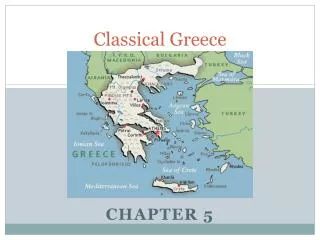
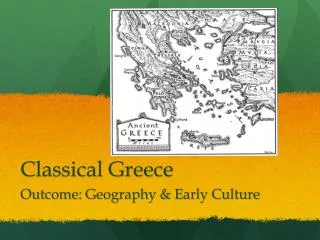
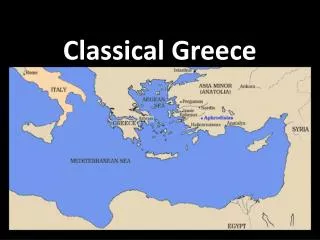
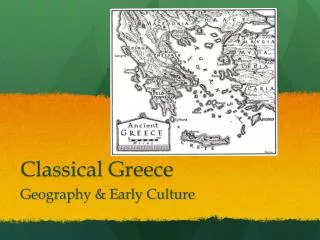
Geography • Includes mainland and about 2,000 islands • The sea & lack of resources encourage travel and trade • Mountains make travel & farming hard • Climate allows outdoor activities
Mycenaeans – Indo-Europeans that settle in Southern Greece. • Trojan War - 1200s B.C. Mycenae fought Troy • Mycenae civilization collapses
Dorians, move in and no records found for 400 years • History through tradtions • Homer – wrote epics (Iliad & Odyssey) • Mythology – develop gods to understand mystery of life. Have human traits.
The City-State • By 750 B.C. the Greek city-state, or polis, is the formal government • A polis is a city and its surrounding villages; 50 - 500 sq. miles • Population often less than 10,000 • Citizens gather on acropolis—a fortified hilltop & discuss government
Governments • Monarchy- • Aristocracy- • Oligarchy- • Tyrant – • Democracy -
Athens – Direct Democracy • Sparta – Military State
Persian Wars • Phalanx – formation of soldiers with spears & shields • Battle of Marathon – Persia vs. Greece
Athens defeats Persia • Pheidippides - runs to Athens to announce Greek victory, “Rejoice, we conquer” then dies. • Athens becomes leader of Greece – 200 city states • Alliance called Delian League.
Assignment • Research daily life in Sparta & Athens • Answer the following questions thoroughly: (pg. 128-131) • 1. The role of government in the lives of individuals • 2. The purpose of education for boys & girls • 3. the responsibilities and privileges of citizens and non-citizens • 4. the roles of women in society
Athens • Golden Age 477- 431 B.C. • How did Pericles’ strengthen Athens? 1.Increased number of officials who were paid salaries. Now anyone can hold office. 2.Uses money from Delian League to build up navy. 3.Beautified Athens
2 - Greeks • Greek tragedy – character with tragic hero • Ex. Oedipus Rex • Greek comedy
Peloponnesian War • Who, What, When, Where & Why? • 1. Sparta & Athens • 2. Peloponnesian War – Sparta declares war on Athens. Athens had strong navy; Sparta strong army. • 3. 431 B.C. • 4. Athens lost.
Philosophers • Athens loses war and questions meaning of life • 1. Socrates: absolute standards do exist, Greeks should examine their life • 2. Plato: Ideal society of 3 groups • 3. Aristotle: argues for rules of logic, scientific method
Alexander the Great • After Peloponnesian War • King Phillip of Macedonia noticed Greece is weak • Defeats Greece, then dies • Son, Alexander is King • He defeats Persia • Empire grows to include all SW Asia • Army fights for 11 years
Hellenistic Culture • Blending of Greek, Egyptian, Persian, & Indian influences • City of Alexandria becomes largest city • 1st Library here contained most of what we know today