Understanding Earth's Energy Balance and the Greenhouse Effect
This chapter explores the fundamental concepts of the Earth's radiation balance, including electromagnetic radiation, the electromagnetic spectrum, and how energy transfer occurs through blackbody radiation. It covers the crucial roles of solar (shortwave) and terrestrial (longwave) radiation in maintaining equilibrium within the Earth’s climate system. Emphasis is placed on the greenhouse effect, which contributes to the warming of the Earth's surface. The chapter also introduces climate modeling techniques, ranging from simple energy balance models to complex General Circulation Models (GCMs).

Understanding Earth's Energy Balance and the Greenhouse Effect
E N D
Presentation Transcript
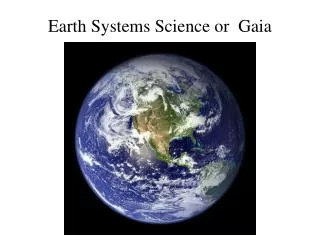
Earth Systems ScienceChapter 3 I. Global Energy Balance and the Greenhouse Effect:The Physics of the Radiation Balance of the Earth • Electromagnetic Radiation: waves, photons • Electromagnetic Spectrum • Flux • Blackbody Radiation • Planetary Energy Balance
ELECTROMAGNETIC RADIATION: WAVES c = speed of light in a vacuum = 3.0 x 10⁸ m/sl = wavelength (m)v = frequency (1/s or s-1)
ELECTROMAGNETIC RADIATION: WAVES Relationship between v, c, and l • vl = c • = c/v Vl/c = 1
ELECTROMAGNETIC RADIATION: PHOTONS E = hv = hc/l E = Energy (joules, or j) h = Planck’s constant = 6.63 x 10⁻³⁴ j-s v = frequency (1/s or s-1) c = speed of light in a vacuum (m/s) l = wavelength (m)
BLACKBODY RADIATION Planck function Wien’s Law Stefan-Boltzman law T = temperature (K) s = Stefan – Boltzman constant
BLACKBODY EMISSION RATES:PLANCK FUNCTIONS FOR SUN,EARTH At the Sun’s surface
RADIATION BALANCE OF THE EARTH: SOLAR (SHORTWAVE) RADIATION Note: area of circle is used here: Pr2 SWin = area * fluxSWin = Pr2S - Pr2SASWin = Pr2S(1-A)
RADIATION BALANCE OF THE EARTH: SOLAR (SHORTWAVE) RADIATION: Why we use the area of a circle Earth
Earth RADIATION BALANCE OF THE EARTH: SOLAR (SHORTWAVE) RADIATION: Why we use the area of a circle
SWin SWout Earth’sEnergy RADIATION BALANCE OF THE EARTH: SOLAR (SHORTWAVE) RADIATION Net SW = Incoming – Outgoing Net SW = Pr2S – Pr2SA Net SW = Pr2S (1-A)
RADIATION BALANCE OF THE EARTH: TERRESTRIAL (LONGWAVE) RADIATION Note: area of sphere is used here: 4Pr2 LWout = area * fluxLWout = 4Pr2sTe4 Earth
LWout Earth’sEnergy RADIATION BALANCE OF THE EARTH: TERRESTRIAL (LONGWAVE) RADIATION Net LW = Incoming – Outgoing Net LW = 0 – 4Pr2sTe4 Net LW = -4Pr2sTe4
LWout Earth’sEnergy RADIATION BALANCE OF THE EARTH: TERRESTRIAL (LONGWAVE) RADIATION Net LW = -4Pr2sTe4 Te = effective radiating temperature
SWout SWin LWout Earth’sEnergy RADIATION BALANCE OF THE EARTH: TOTAL RADIATION Assume dynamic equilibrium: IN = OUTNet SW + Net LW = 0Net SW = Pr2S(1-A)Net LW = -4Pr2sTe4Pr2S(1-A) – 4Pr2sTe4 = 0sTe4 = (S/4) (1-A) Te = [ (S/4s) (1-A) ]0.25
RADIATION BALANCE OF THE EARTH: TOTAL RADIATION Te = [ (S/4s) (1-A) ]0.25 S = 1370 W/m2A = 0.3s = 5.67 x 10⁻⁸ W/(m2-K4) Te = 255K = -18°C = 0°F
RADIATION BALANCE OF THE EARTH:GREENHOUSE EFFECT Te = 255K Ts = 288K DTg = Ts-Te DTg = 33K = 33°C = 59°F
SW LW Earth’s Atmosphere Earth’s Surface RADIATION BALANCE OF THE EARTH:GREENHOUSE EFFECT You can do the same calculation including an atmosphere
Note: logarithmic scale ! Vertical Pressure and Temperature Structure
SW A*SW SW A*SW Effects of Clouds on the Atmospheric Radiation Budget: SW radiation
Effects of Clouds on the Atmospheric Radiation Budget: LW radiation
Introduction to Climate Modeling • Many types of climate models exist. We discuss some of the more common types, which have different levels of complexity: • Zero-dimensional radiation balance models • 1-dimensional radiative-convective models • 2-dimensional diffusive models • 3-dimensional Atmospheric General Circulation Models (AGCM) • 3-D coupled atmosphere – ocean models (AOGCM)
SWout SWin LWout Earth’sEnergy Introduction to Climate Modeling:zero-dimensional radiation balance model Te = [ (S/4s) (1-A) ]0.25
Introduction to Climate Modeling:1-dimensional radiative-convective model One-Layer Radiation Model
1-D Rad-Conv Model S/4 (S/4)*A Radiation in each wavelength band surface Introduction to Climate Modeling:1-dimensional radiative-convective model Convection, latent fluxes Surface: latent, sensible
Introduction to Climate Modeling:2-dimensional climate model North Pole South Pole Surface
Introduction to Climate Modeling:3-dimensional General Circulation Model (GCM) surface http://www.arm.gov/docs/documents/project/er_0441/bkground_5/figure2.html
Atmosphere Ocean Introduction to Climate Modeling:3-D coupled atmosphere – ocean models
Water vapor feedback snow/ice albedo feedback IR flux/temp feedback Climate Feedbacks Cloud feedback ???