The Constitution
150 likes | 262 Vues
This chapter explores the foundational principles of government as outlined in the Constitution. It emphasizes limited government, self-government, and the essential role of the people as both the source and beneficiaries of governing authority. The text highlights key Enlightenment thinkers such as John Locke, Montesquieu, and Rousseau, touching on significant events leading to the formation of the Constitution, including the Declaration of Independence and the Articles of Confederation. The Great Compromise, Three-Fifths Compromise, and debates between Federalists and Anti-Federalists are also discussed, illustrating the intricacies of establishing a balanced government.


The Constitution
E N D
Presentation Transcript
The Constitution Chapter 2
Principles of Government • Limited Government • Strict limits on lawful uses of power • Limits on depriving people of liberty • Self-Government • People are source and beneficiary of governing authority • Majority rule • Popular Government • Majority’s desires have more direct and immediate impact on governing officials
Origins of the Constitution • Enlightenment • Reason • Natural laws • Progress • Liberty • Toleration
Key Leaders • John Locke • Born with natural rights • Life, liberty, property • Government is based on the consent of the governed • Contract where rulers protect the people's natural rights • If rulers betray the social contract, people have the right to replace them • Charles de Montesquieu • Spirit of the Laws • Separation of powers • Jean-Jacques Rousseau • Social Contract • Sovereign power resides in the will of the people • Fail to carry out the people’s will, they can be removed
Four Significant Events • “the rights of Englishmen” • Resistance of taxation and control of England • Declaration of Independence • Inalienable rights • Articles of Confederation • Formed during the Revolutionary War • Created weak national government • States retained “sovereignty, freedom and independence • Prohibited Congress from interfering in states’ commerce policies • Prohibited Congress from taxation • Shays’s Rebellion • Weakened CongressNation Dissolving • Farmers, led by Daniel Shays, marched to prevent foreclosures on their land and cattle • Motivated Congress to meet in Philadelphia to revise Articles of Confederation • Needed a stronger central government to maintain order, protect property, and promote commerce
The Framers • “An Assembly of Demi-Gods” • 55 delegates attended • Rhode Island refused to send delegate • Jefferson not there-in France • Shared Ideas • Human nature • Political Conflict • Purpose of Government • Nature of Government
The Great Compromise • Two-Chamber Congress: Compromise • Virginia (large-state) Plan • Bicameral legislature • Representation dependent upon population number • Greater power to larger state • New Jersey (small-state) Plan • Unicameral legislature • Each state would have one vote • Equal power to large and small states • Result: • House of Representatives based on population • Senate-two votes for each state
Three-Fifths Compromise • Slaves accounted for 30% of total population in the south • Many northern delegates opposed slavery • Compromise • All “free persons” and “three-fifths of all other persons” counted for representation • Same formula used for taxation
Ratification • 9 out of 13 to approve • Nationwide debate • Anti-Federalists • Small farmers, shopkeepers, laborers • Favored strong state governments and weak national governments • Called for Bill of Rights • Federalists • Large landowners, wealthy merchants, professionals • Favored weaker state governments and a strong national government • Promised to add amendments specifically protecting individual liberties • Federalist Papers • 85 essays written by Hamilton, Madison, and Jay
Three Branches of Government • Legislative Branch • Article I – bicameral Congress – two chambers – House & Senate • Executive Branch • Article II – led by a president chosen by electoral college • Judicial Branch • Article III – judicial branch with Supreme Court
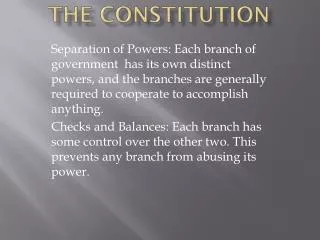
Checks and Balances • Guard against tyranny and restrain irresponsible majorities • Divide the authority of the government • Shared InstitutionsChecks & Balances • Shared Legislative Powers: Congress checked by the president, Supreme Court • Shared Executive Powers: President checked by Congress • Shared Judicial Powers: Courts checked by the president, Congress
Judicial Review • Power of the Supreme Court to determine if acts of Congress and the President are in accord with the Constitution • Not specifically described in the Constitution • Est. by Marbury v Madison (1803)
Constitutional Change • Proposal: • 2/3 vote in both houses of Congress • National constitutional convention called by Congress by request of 2/3 of state legislatures (never been used) • Ratification: • By legislatures in ¾ of the states • By conventions in ¾ of the states
Methods of Informal Change • Congressional legislation • Executive actions • Judicial decisions • Party practices • Unwritten traditions
Change Over Time • Jeffersonian Democracy • Government belonged to all, not just elite • Jacksonian Democracy • Voters choose president through electoral college • The Progressives • Direct election of senators • Delegates carry out wishes of the voters