
SlideServe
Menu
Préférences
© SlideServe · v2026

How do you BIM an existing building?

nami avatar
24 diapositives · 477 Views · Jul 11, 2014

How do you BIM an existing building?. South West BIM Hub Ben Rouncefield-Swales URS – Sustainable Design & Construction ben.rouncefield-swales@urs.com 07917 898548. One of the world’s leading engineering, construction and technical services firms. Focuses on four key markets:
How do you BIM an existing building? - slide 1
01 / 24How do you BIM an existing building?
1 / 17

Télécharger la présentation

How do you BIM an existing building?
Une image / un lien ci-dessous est fourni (tel quel) pour télécharger la présentation

Politique de téléchargement : le contenu du site vous est fourni TEL QUEL pour votre information et votre usage personnel ; il ne peut être vendu, concédé sous licence ni partagé sur d’autres sites sans l’accord de son auteur.Le contenu vous est fourni TEL QUEL, pour votre information et votre usage personnel uniquement. Téléchargez la présentation en cliquant sur ce lien. Lors du téléchargement, si vous ne parvenez pas à télécharger une présentation, l’éditeur a peut-être supprimé le fichier de son serveur.Pendant le téléchargement, si vous ne parvenez pas à obtenir une présentation, le fichier a peut-être été supprimé par l’éditeur.

F I N

Plus de contenu associé

Transcription de la présentation
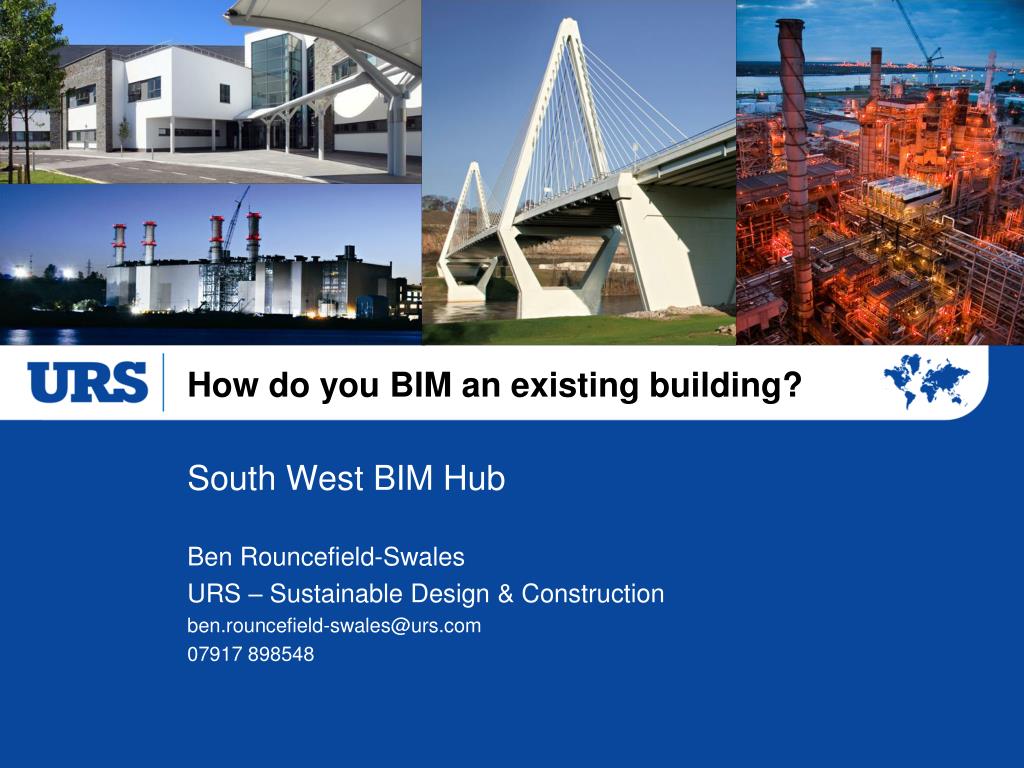
  1. How do you BIM an existing building? South West BIM Hub Ben Rouncefield-Swales URS – Sustainable Design & Construction ben.rouncefield-swales@urs.com 07917 898548

  2. One of the world’s leading engineering, construction and technical services firms. Focuses on four key markets: Infrastructure Governments Power Industrial & Commercial Fully integrated services support full project lifecycle. Serves federal, national, state and local government agencies, FORTUNE 500 companies and other multinational corporations. Approximately 57,000 employees in more than 50 countries worldwide. URS - Overview 2

  3. Who cares about existing buildings? Buildings are responsible for 40% of global energy demand But 70% of all buildings in 2050 are already built

  4. What are the Drivers for Change? Energy costs drive landlords to improve the thermal efficiency of their existing building stock The EPBD - net-zero energy by 2019 for all new buildings, and carbon neutrality by 2019 for all new commercial buildings Unable to let E rated buildings from April 2018 Rising energy costs will force occupiers to adopt sustainable operations and improve the efficiency of M&E equipment Research shows higher rental income secured for buildings with sustainability credentials The Green Deal intended to stimulate the improvement of energy efficiency in existing buildings Carbon Liability: schemes like the CRC require private and public energy users to pay a tax on their energy bill

  5. What is happening now? • Traditional energy audits • Cost can vary depending upon level of output required • Some modelling may be done for high investment items – usually at design stage • More involved AM&T contracting • High cost and long contract periods • Creates good data but still need to work up into opportunities • Typically outputs are data not models • Energy Performance Contracting • Investment grade energy audit • Detailed modelling to underpin finance • No initial cost to client but pays through savings • Do It Yourself • Success varies depending upon in-house skills • Unlikely that any modelling would be done

  6. That’s why URS developed REM • Rapid Energy Modelling • A tool developed by URS in partnership with AutoDesk • Uses innovative means to quickly construct a 3D model of the building • Physical Audit feeds information into the model • ReVit models the building and tests improvement measures • Ouptut leaves a legacy model for the building MANAGE PLAN BUILD DESIGN

  7. The REM process

  8. Laser scanning

  9. Photogrammetry

  10. 3D sketching

  11. Rapid Response • From the laser scan – in 2 hours • No drawings required – photogrammetry builds a 3D model • From a floor plan – in 30 minutes • Generated from 2D plans & elevations using AutoCAD, Revit, Vasari, Google Sketchup etc.

  12. Immediate decision making

  13. Option & Sensitivity Studies - Readily Undertaken Unimproved With external shading Alter key building elements and observe impact on energy & CO2 outputs and also quality of internal space

  14. Example output - recommendations

  15. Case Study 18

  16. City of London office - introduction • Late-Victorian office • Multi-tenanted • Circa 3,500 m2 • 7 stories • Energy spend c. £50k p.a.

  17. City of London office – REM • Site visit circa 3 hours • Photogrammetry model • Rapid Energy Model created • Accuracy <10% difference * *includes small power, computers, communications equipment, printers etc

  18. City of London office – Improvement Recommendations

  19. City of London office – Improvement Recommendations

  20. REM experience across the Built Environment

  21. Summary 24

  22. Key issues • Lots of buildings – most already built • Poor understanding of building performance • Traditional audit / survey take a long time • Need to act now to meet commercial imperatives: • Delivering cost savings • Improving energy performance • Enhancing working environment • Reducing carbon emissions

  23. What benefits will REM bring? • It helps reduce a building’s energy running costs and CO2 emissions • It provides a rapid focus on building improvement options • It is a Building Information Modelling (BIM) process, creating a legacy model that can be retained and refined • Improves building user environment

  24. Ben Rouncefield-Swales Associate URS – Sustainable Design & Construction ben.rouncefield-swales@urs.com 07917 898548 Thank You 28