Cell Theory and the Cell
Cell Theory and the Cell. Cell Theory. Term “cell” was coined in 1665 by Robert Hooke He looked at a slice of dried cork All living things are comprised of cells. Cells are the smallest “living” unit in an organisms. Cells come from previously existing cells. Cell Diversity.

Cell Theory and the Cell
E N D
Presentation Transcript
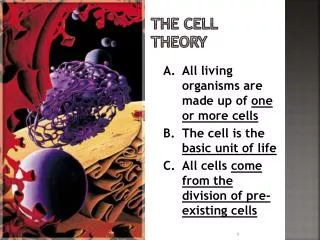
Cell Theory • Term “cell” was coined in 1665 by Robert Hooke • He looked at a slice of dried cork • All living things are comprised of cells. • Cells are the smallest “living” unit in an organisms. • Cells come from previously existing cells.
Cell Diversity • Lots of shapes and sizes
Cell Organization • The cell • Cell membrane • Cytoplasm • Cytosol • Organelles
Cell Membrane • Outer boundary • Physical • Chemical • Comprised of two layers of lipid (fat) • Outer and inner layers • Proteins • Proteins give the cell its unique “personality” or function
Function of Membrane Proteins • Transport (in and out of cell) • Receptors • Cell adhesion • Cell recognition
Cytoplasm • Is comprised of: • Cytosol • Organelles
Cytosol • Intracellular fluid • Contains dissolved nutrients, ions, proteins and waste products
Organelles • Endoplasmic reticulum (ER) • A network of membrane-bound tunnels throughout the cytoplasm
Two Types of ER • Rough ER (rER) • Smooth ER (sER) • Names based on appearance
ER Rough ER Smooth ER
rER • Has particles attached to outside of membrane
Ribosomes • These particles attached to rER are ribosomes. • Ribosomes are the site of protein synthesis within every cell.
sER • sER doesn’t have ribosomes attached. • sER function – lipid (fat) synthesis
Golgi Apparatus • Flattened membranes • Involved in packaging and secretion of proteins
Mitochondria • Bean shaped • Outer and inner membranes
Mitochondria • Inner membrane folded into cristae • Adenosine triphosphate (ATP) produced on cristae. • ATP is high energy compound. • ATP only produced in mitochondria.
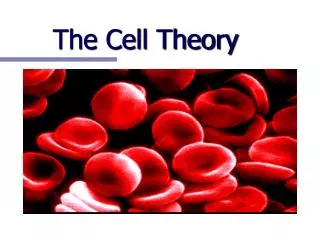
Nucleus • Control center of cell • Contains DNA/chromosomes • Genetic repository for ~ 35,000 genes • Genes control the synthesis of proteins in each cell. • Red blood cells don’t have a nucleus. • Skeletal muscle cells have multiple nuclei.